
Talking Points: How do you feel about hot-desking?
Lee Day, design director of Sketch Studios, says that the loss of personalised workspace has been replaced with something more powerful.

Words by Lee Day, Sketch Studios
Only a decade ago we would come to work and sit at the same desk in the same office with the same people. Desks would be crammed with personal mementoes: framed family snaps, pictures of colleagues at the Christmas party, cuddly toys and reams of yellow sticky notes. Staff would decorate their monitors and stuff their pedestal full of gym kit, spare shoes, make-up, snacks, tea-bags, old lunch and everything in between. The desk reflected the personality of its occupant. It was a true home from home.
Technology, and the increasing cost of property, changed all of that. The pedestal was the first thing to go, replaced by centralised lockers. The desk went next through the introduction of hot-desking and agile working.
Even the humble wastepaper bin met its demise, thanks to centralised recycling facilities driven by a focus on sustainability. While these changes reflect a more flexible working environment, has this come at a cost, with people no longer so emotionally attached to their workplace? Yes, British workers have lost an element of individualisation and personalisation during the past decade. But they have found instead an environment which encourages them to participate in the workspace around them, rather than simply shackled to a single static piece of furniture.
Gone is the need for a sea of L-shaped desks and fabric screens that workers customise with pictures and mementos to make them feel more at home. Social media and technology devices have replaced this and give people an ever-changing backdrop to their lives and the people they share it with. Desk screens are now lower, which aids communication rather than hinder it.
Today's office design is about creating an environment that reflects and supports a company's culture and the lifestyle of its employees, not simply an environment to fill with desks. To attract the best people, employers with foresight recognise the need to provide distinctive and appealing environments - not just somewhere you can stash your stuff and huddle in a corner for most of the day. There is also increasing evidence of the health benefits to employees who have greater mobility throughout their working day. The human body wasn't designed to sit in one position for eight hours, no matter how good the task chairs are.

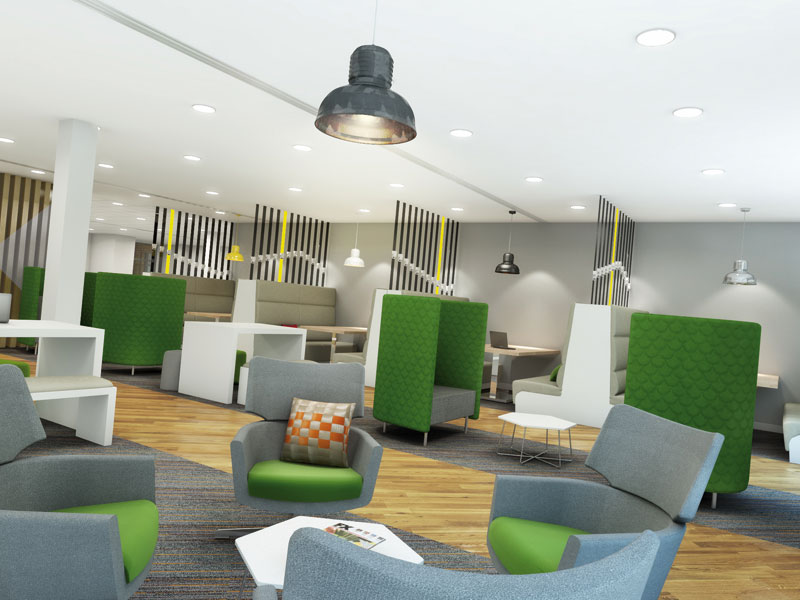
Cafe-style furniture, comfy sofas and pods are bringing a domesticity into the workplace, supporting employees' emotional needs
New technology supports the way people work now, so rather than being based at a permanent 'workstation' complete with a computer monitor and a desk phone, workers now get to choose from a landscape of workspaces that can suit all their activities and tasks, personalities and preferences.
This mobile culture means the picture of dog, child or partner can be stored on your phone or laptop and moves with you.
You become the platform. And instead of sticking pictures up around a computer monitor, shared staff walls and notice boards to which everyone can contribute encourages a feeling of home. Instead of people staying in their own personal silos, a family environment is created.
Every person's day differs depending on the tasks at hand. A typical working day might require collaboration time with colleagues, formal meeting time with clients, and parts of the day when a quiet, more secluded, spot is needed for individual work.
The new generation of workplace provides all those spaces through a variety of zones, where you can meet, work quietly, eat lunch, drink coffee and occupy all of the available space.
The amount of time you spend at your desk is no longer a measure of your productivity - instead it is widely acknowledged that staff should be encouraged to move through the workspace to help stimulate their creative thinking and engage with co-workers.
In this way, the modern office encourages people to work in the most productive way for any given task, with the design and layout of the workspace more than making up for a loss of personal space by helping to facilitate new and better ways of working.