
Terence Conran - interview
As Habitat, the iconic home ware brand that Terence Conran created in 1964 prepares to celebrate its 50th birthday, we revisit an interview with the man himself, first published in Blueprint in November 2011

Interview by Johnny Tucker
This interview was first published in Blueprint magazine, November 2011
Terence Conran is 80 and it's hard to think of anyone in Britain who has had quite the same impact on design in this country. How many truly household names are there in our design industry let alone ones who have changed the nature of our very households?
From its launch in the Sixties, Conran grew Habitat into a veritable retail empire, designing many of its products himself along the way. And when his retail reach had stretched into Mothercare and the launch of Next, a new phase started as he used his wealth to evangelise design to both government and the public through channels such as the Conran Foundation and the naissant Design Museum.
There was also the small matter of putting money into a new magazine launch: Blueprint. 'Richard Rogers persuaded me to make a contribution because I had lots of money at the time. So I saw their [editor, Deyan Sudjic and publisher, Peter Murray's] plans for what was a very exciting magazine and I suppose I felt about it the same way as I did about the Design Museum: as a way of proliferating ideas.'
 The Thetford factory to which Conran moved his manufacturing in 1962
And then, of course, he set his sights on the world of restaurants. It wasn't a new thing, he'd been designing coffee bars and small restaurants such as the Soup Kitchen and the original Orrery, virtually from the off, but now he took the capital's eating scene by storm, almost creating that too.
Pretty much anyone who was grown or growing up in the Eighties went to Quaglino's didn't they? It captured the brash zeitgeist perfectly at the time. His restaurants popped up all over world and are still appearing, most recently with Boundary in Shoreditch and Lutyens in Fleet Street. And during all this time, of course, there has been Terence Conran the commercial designer, of which Conran & Partners is the current iteration. His track record is there for all to see.
So who exactly is Terence Conran? Is he a designer, a retailer, a restaurateur, a Renaissance man? 'I would've said, if I was allowed to describe myself,' Conran muses, 'an entrepreneurial designer interested in the quality of life.'
He is also a very hard-nosed businessman. Make no mistake about that. His protege, Stephen Bayley, says one of the main things Conran taught him was 'never do anything for free!'
But now Conran has reached 80, he's decided to kick back and relax... Of course, he hasn't. He has a list of projects flying round his brain and at his fingertips, from the just-launched collection of furniture for M&S, to a raft of Conran & Partners hotels currently on the drawing board. 'I love doing new projects, planning new projects, designing new projects and seeing them built and opened up and running. Something like the Boundary was a terribly complicated project to build - all sorts of problems with planning, which can become extremely frustrating, but nevertheless the entrepreneur in me can cope with problems that send most designers round the bend.'
We're sitting in his apartment atop Butler's Wharf. Conran bought the 14 acres here at the start of the Eighties, when it was 'totally derelict and the only inhabitants were rats. You'd ask a taxi driver to take you there and they'd never heard of it.'
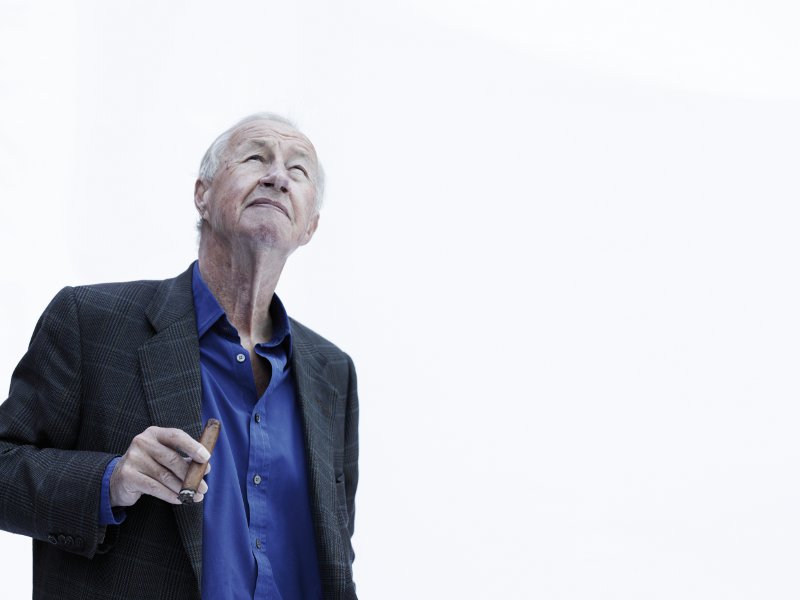
The apartment is stylishly minimal and comfortable with a hard-working kitchen taking up a large part of it - no surprise there. And also unsurprisingly he's sporting a deep blue - Conran-blue - shirt and occasionally puffing on a Cuban cigar: 'I had my first cigar on the opening night of Habitat. A designer gave me one - it's a tradition to smoke a cigar to celebrate when you have a baby!'
As the aromatic smoke curls around him, Terence Conran talks quite slowly and measuredly, but also fervently about design and its ability to right many of the country's wrongs. He uses the phrase 'passionate' in relation to design many times throughout our conversation which covers everything from well-documented past glories to future projects. In fact, while more than happy to talk about the past, he's very keen to make sure that you know about all the work he is currently involved in and has planned. Part of that is also his ambassadorial role to promote design in education and government:

'There aren't enough positions in the industry for the number of designers we are turning out because of the state of manufacturing in this country. I think what designers could do - and I've just finished my stint as provost of the Royal College and so I'm fairly well aware of what senior postgraduate designers can do - they can create, maybe with young engineers or other entrepreneurial people, they can create manufacturing businesses and can start making things. My interest is also in trying to get government to understand how design can contribute to the economy and help the UK become certainly never the workshop of the world again, but a workshop nonetheless.'
Another thing that gets him excited is the plans for the new Design Museum, an on-going pet project of his, to which he has now contributed about £50m.
'I passionately believe that design and technology must be taught in schools and the new Design Museum will be able to play a major role in teaching teachers to teach. Why it's so difficult is that some wretched guy who has been a woodwork teacher is asked to teach design and he doesn't know where to start. It's also going to become the place to take foreign dignitaries to show them what's happening.'
 Early advertising poster for Habitat
One thing that doesn't enthuse him, though, is Argos taking over his 'baby' - Habitat - but, interestingly, he regards the M&S work as his 'new Habitat' and when we spoke he had further plans regarding the chain: 'I'm very depressed about Habitat now. Three shops only left in the UK, owned by Argos. I know that the brand name is still important and that's why Argos bought it. In continental Europe it still exists and it's more or less complete and I've been asked to go and see the people who bought it there in Paris next week, so we'll see what they say.'
So, once again it seems Conran is moving on, looking to the future with an eye for a main chance, a discerning, designled eye for a main chance. Plus ça change.

Boundary in Shoreditch

Conran's most recent restaurant, Lutyens
'I started with workshops in derelict premises in London, one in North End Road, Fulham, in an amazing place that had been a forage merchant's, and at that time there were still ponies and carts that used to turn up and get their food. The GLC started to promote the idea of moving industry out of London... and I did the most complicated thing that I've ever done in my life, which was persuade 80 families that they'd like to move out of London and live in the country.'
1964 The first Habitat shop opens in Chelsea. The staff wear Mary Quant-designed uniforms and have their hair styled by Vidal Sassoon. Third son, Tom, is born to Conran and third wife, Caroline Conran 'I decided with our sales manager that we'd make a trip round the UK to look at all these retailers who'd bought our furniture and see what sort of success they'd had. It was the most depressing trip because not one of the retailers that we visited had any clear philosophy and in most cases our furniture wasn't properly displayed or assembled. In some cases, it hadn't even been unpacked. There were fluorescent lights everywhere, grey counters, merchandise just stacked up, no display. So, the view was, "Let's give up trying to make domestic furniture, go back to our contract furniture." I wanted to demonstrate that there was a demand for domestic furniture, so I said, "Let's open our own shop." We found this building on the Fulham Road and we got a decent amount of space for a reasonable rental. We also saw that people didn't buy furniture very frequently so what we needed to do was sell all the other things, textiles, lighting, china, glass - kitchen in particular - with which the home was furnished. It was an attitude of trying to help people decide how they wanted to live and providing the equipment which allowed them to do it.'

 | Thomas Heatherwick In my formative years Terence Conran was the only person who seemed to combine business with design... |
 | Richard Rogers In 1974, Renzo Piano and I were working in Paris on the Centre Pompidou, when a call came from Terence Conran asking if it would be possible for him to have a tour of the building.... |
 | Stephen Bayley Ten things Terence taught me: |