
Placemaking: If you build it will they come?
It takes more than money and a big-name architect to create genuine places, says Veronica Simpson.

Grandiose cultural buildings are popping up all over the world, in the jungles of Panama and scattered along the shoreline of Hong Kong, as a quick fix for civic stagnation and public neglect - a kind of cultural Viagra. But what can architecture alone hope to achieve? This was the topic of a talk last year curated by The Architecture Foundation at Tate Modern. It showcased three ambitious global schemes, all in cities currently underserved by public cultural space: Abu Dhabi, Hong Kong and St Petersburg.
Abu Dhabi was doing what the Middle East does best: find a piece of unused/unusable land, fly in some of the most high-status global architecture brands on the planet, and ask them to create a 'signature' building, in the hope that their innate brand values will do the rest. No need to try and knit these cultural institutes into any existing community, or urban fabric. There isn't any.
Actually, Jean Nouvel's Louvre-approved art gallery is an interesting response in that the practice has tried to replicate an ancient part of a city in its clustered room layouts, quirky corridors and meandering interplay between roomscape and landscape. One of the most inspired elements is a highly perforated steel parasol that sits over the top of the building. It facilitates natural air circulation but also adds a decorative patterning, sending a million tiny shards of light and shadow across the white-walled rooms. But flanked by a Foster building on one side and a Gehry on the other, this is placemaking of a very Disneyesque, architectural theme-park kind.

Jean Nouvel's Louvre-inspired art gallery for Abu Dhabi stands alone in a cityscape lacking cultural cohesion. Photo Credit:Ateliers Jean Nouvel - Developer: TDIC (Tourism Development & Investment Company)
St Petersburg offered something with a little more social and cultural traction, reinventing a piece of the city previously off limits to civilians: New Holland Island, where the Russian navy was developed and shipbuilding concentrated for 300 years until it fell into neglect and disrepair post-Glasnost. Ringed by canals and blessed with tall, 18th-century brick storage sheds, the plan is to turn the whole island into a residential and cultural community. The existing buildings will become aspirational canal-side apartments, while a new art gallery and extensive public parks will animate the island. The design, by Work Architecture, majors on restoring and sensitively adapting the old timber sheds and creating public access around them through a continuous loft-space promenade. The art gallery itself fits neatly into a gap between the old buildings and does everything it can not to upstage them.
Hong Kong's proposed cultural quarter in West Kowloon is a piece of land reclaimed from the sea, masterplanned by Foster + Partners to house 17 cultural buildings - performance spaces, art galleries, auditoria and theatres - among public parks. Of course there are plenty of premium high-rise apartments and offices crammed in, but there are laudable civic elements too - like siting all the public buildings along the riverfront, with extensive greenery and parkland between them and the water so that ordinary people can enjoy the spectacular views around the bay. The commercial and residential tenants will get those views from their penthouses anyway.
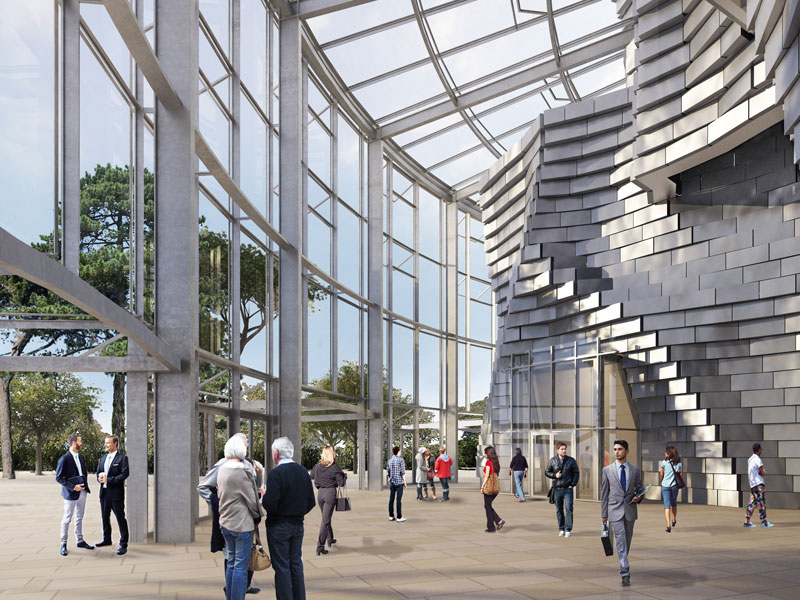
In April, however, I had the good fortune to be present at the inauguration of a very different kind of culturally inspired regeneration project: the Luma Foundation's new arts campus in Arles, France, with a flagship building by Frank Gehry (the building will be finished in 2018). It's easy to become cynical about Gehry's role as the poster boy for culturally led regeneration. Following the extraordinary success of the Guggenheim Bilbao, it seems Gehry is first choice for anyone who wants an iconic cultural building that will completely reframe the way their city or region is perceived, regardless of how coherent or functional the actual building is.
On this occasion, however, I'm optimistic that the scheme will succeed. Gehry has a strong connection with this region and the building has emerged from a very close dialogue with his client. At the press conference, he demonstrated the evolution of the building's form, inspired by the Camargue's rough terrain and windswept landscape and the paintings of the one who immortalised it, Vincent van Gogh. 'This building would not work anywhere else,' he says. The rippling cloak of stainless steel tiles that coats the structure is strongly evocative of Van Gogh's fierce, dynamic brush strokes. And its surface will undoubtedly dazzle and delight, by sun or moonlight, in the 'painterly' fashion requested by his client, the philanthropist and heiress Maja Hoffman.
The building is just one element, though it is the one that will attract tourists, host events and engage with the public. Other parts of this still largely derelict industrial complex, built in the 19th century for the renovation of trains, are being creatively reused: vast engineering sheds are being redeployed as gallery spaces, and old workshops are being restored by architect Annabelle Selldorf for creative collaborations between multidisciplinary teams of artists.
Belgian landscape designer Bas Smets will transform the central area into a public park. However, the key ingredient for me is the fact that Maja Hoffman grew up in Arles, is passionate about the region and the people and gives generously of her time and energy as well as cash to artists and major arts institutions.
She has worked tirelessly to make this scheme happen, to turn this site into an exciting 'laboratory' for artistic collaboration and experimentation, and at the same time bring her town to prominence and prosperity. The financing is crucial, but the generosity and inclusivity of the scheme leader and her team's vision is what will drive this regeneration scheme to a happy conclusion for all concerned.
No matter how starry the architect employed, buildings alone cannot transform destinations into communities. Though it often does take the star power of a particular kind of architect to make them happen at all.