
Net Zero - The quest for net zero
Is it possible, or affordable, to retrofit historic buildings? Kay Hill asks the difficult questions

RETROFITTING HERITAGE PROPERTY to net zero is like seeking world peace – everyone thinks it’s a great idea, but how to achieve it is another question entirely. With nearly a third of commercial property in the UK built before 1919, the scale of the problem is vast – and the cost even more so, with the government’s adviser, the Climate Change Committee, estimating that meeting the UK’s target of net zero by 2050 will cost £1.4trn.
Despite the cost and difficulty involved, many architects are feeling positive. ‘It’s good that we’re all talking about it,’ says David Weatherhead, senior design principal at HOK. ‘Our urban fabric is full of important buildings, the quality tends to be high and they have been built to last. Churches aside, not many historic buildings today are still in the use they were designed for, but we can find a new use for that quality and robustness.’ Nuno Correia, head of sustainability at WilkinsonEyre, agrees: ‘Retrofitting our existing building stock is absolutely essential to decarbonising the built environment and achieving net zero carbon.’

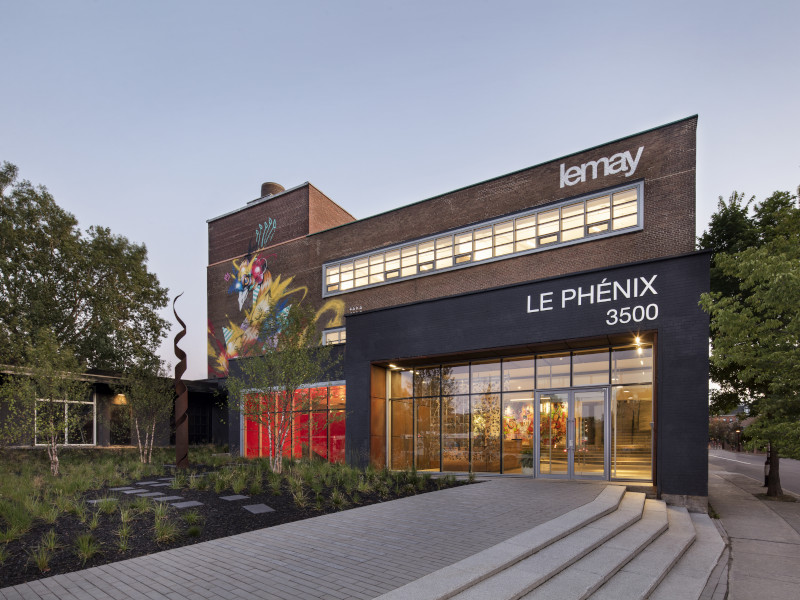
The Phenix, Montreal Lemay used its own Montreal HQ as a test bed for transforming an older building into a sustainable one. The company chose a 1950s warehouse to house its 350 staff, creating a biophilic environment with a living green wall, daylight and views. Reducing emissions during the transformation and in use was a priority, and Lemay’s innovations, including on-site production of renewable energy through photovoltaic and thermal panels, proved it was possible to renovate a building to be net zero for the same cost as similar new-build. Named The Phenix, the building has a maximum three-star Fitwel rating, Zero Carbon Building Standard and is LEED-Platinum certified. Architect Lemay
Engineer Martin Roy and Associates. Image Credit: Adrien Williams
While creating a new net-zero building is straightforward, transforming heritage buildings presents greater challenges. ‘It requires a case-by-case approach considering whole-life carbon, with an understanding that embodied carbon is a key contributory factor,’ says Correia. ‘Heritage building envelopes and their materials present highly complex issues associated with improving fabric performance. There is a need to balance reasonable interventions with an understanding of the significance of these buildings; their accrued cultural and historical value – which represent less tangible, but still important, facets of sustainability.’
 Image Credit: Seamus Payne
‘Not all buildings are net-zero retrofit candidates,’ admits Phillip White, associate principal at CO Architects. ‘Certain buildings may have historic or cultural value, and the energy improvement would undermine the building’s character-defining features – historic single-pane windows being one example. In these cases, project teams should try to offset those signature features by supplementing and improving the efficiency in other areas, such as providing superinsulated exterior wall assemblies.’
‘For any refurbishment or repurposing of historic buildings, it is first necessary to understand the significance, whether historical, architectural or cultural,’ says Chris Davies, head of conservation at WilkinsonEyre. ‘Thermal upgrades and improvements to the operational energy have to be weighed against the harm they might cause to this special interest. We have to resist net zero at any cost because we, as a society, still choose to highly value our historic buildings, which stand somewhat outside conventional economic reckoning. Historic buildings are best maintained when they are occupied and this is only possible within the real-world conditions of a viable, long-term, use.’
 Image Credit: Seamus Payne
It’s a conundrum that is particularly relevant to custodians of the UK’s historic churches. The United Reformed Church, Church of England and other denominations have committed themselves to reaching net zero even earlier than the politicians – by 2030. Clifford Patten, director at Lewis Patten Architects and member of the United Reformed Church Net Zero Task Group, explains: ‘There is a degree of understanding that the timescale, ongoing technological developments and funds available make this an unrealistic task, but it has been set with a strong belief that this is what the Church is being called to do. Churches would say that we have no option, but to preserve creation and protect those whose lives will be severely impacted by our actions and the resulting climate change consequences.’
For some churches, access to grant funding, generous congregations or tourism potential has facilitated radical retrofits – for example, in 2023, St Andrew-by-the-Wardrobe, designed by Sir Christopher Wren, became the first Grade I listed church in London to go carbon neutral after an 18-month, £1.1m refurbishment that included six air-source heat pumps, roof insulation and LED lighting. But while the Church of England has found the funds for nearly 200 solar panels and basement battery storage at the magnificent York Minister, the harsh reality for many churches contemplating million pound refits to cherished but little-used buildings is more likely to be closure.
 Hotel Marcel, New Haven, Connecticut Becker + Becker converted a historically protected 1970s brutalist building by Marcel Breuer into a LEED Platinum-certified Passive House hotel that will be US’s first net-zero hotel by the end of 2025. Originally the headquarters for Armstrong Rubber Company, then Pirelli, the building spent 20 years owned by Ikea but used as a giant billboard for a neighbouring store. It was bought by Becker + Becker in 2019 and transformed into a fossil-free electricity-powered 165-room hotel. The retrofit included over 1,000 solar panels, sealing the concrete panelled walls and installing air-source heat pumps and light wells. Original architect Marcel Breuer Architect and developer Becker + Becker Interior deisgn Dutch East Design Structural engineering GNCB Consulting Engineers. Image Credit: Seamus Payne
‘Investment in these measures will be beyond the majority of historic community and church building owners without significant external funding, and for that reason we encourage a process of review and rationalisation to be sure that the measures are only applied to the useful elements of the building,’ admits Patten. Other churches have chosen low-key if less comfortable options – such as St Michael’s in Baddesley Clinton, near Birmingham; a medieval, Grade II listed church that achieved net zero with a budget of just £3,880, by switching to renewable electricity and installing electric pew heating and LED lighting. Such a pragmatic approach is not a bad thing, notes Chris Davies: ‘It may be that we need to accept a broader definition of climatic comfort with a greater acceptance of temperature variation, as would have been experienced by earlier generations, in order to preserve the essential character of historic fabric.’
A degree of compromise – both in terms of historical preservation and net zero – can go a long way towards achieving acceptable outcomes. For example, says Davies: ‘The Grade II* Battersea Power Station represents a case in which considerable intervention in the building was justified to save it from loss, and introduce viable new uses. The interventions, are, however, proportionate, reflecting and enhancing the historic character of the building. While net zero was not the defined objective, considerable carbon efficiency has been achieved in the embodied carbon retained, the thermal coherence of the rehabilitated building, and the introduction of modern servicing. In some areas, such as the vast Turbine Halls, all parties agreed that spaces could remain unheated and still provide satisfactory levels of comfort for visitors.’
 Two net zero churches The Church of England has committed to achieving net zero by 2030, but the way this is achieved varies immensely. At one end of the scale, St Andrew-by-the-Wardrobe in the City of London – a Grade I listed church designed by Sir Christopher Wren (pictured right and left) reached net zero after an 18-month closure to implement a £1.1m retrofit that included six air-source heat pumps in the roof and insulation. A more low-key solution was implemented at St Michael’s Baddesley Clinton, a medieval Grade II listed church near Birmingham. As it was only used for a weekly service, expensive interventions were rejected in favour of fitting low-energy electric heating directly into the pews, run from a green tariff, costing just £3,880.
Compromise was also reached by Moat in Essex. Using an EU grant, the housing association and Energiesprong retrofitted five 1930s social homes with solar panels and batteries, heat pumps, triple glazing, floor insulation and external cladding to reach net zero. But with funding no longer available, it refurbished a further 30 homes itself, but switching to internal insulation and postponing heat pumps and batteries until the gas boilers need replacing – still raising the EPC from D to B. ‘The speed and scale of works required to meet net zero 2050 targets need to increase significantly, and this won’t be possible with current funding options,’ says Ben James, Moat’s sustainability manager.
Not everyone is inclined to compromise, however. Carlos J. Cardoso, partner at US practice Beyer Blinder Belle, takes a harder line: ‘Historical or existing buildings should be retrofitted to become energy-efficient, otherwise they will be obsolete. There is no compelling reason to keep a historical or existing building non-compliant with today’s energy standards.'
The furore over plans to demolish Marks & Spencer in Oxford Street has raised public awareness of embodied carbon. According to Julian de Metz, director at dMFK: ‘Compared to new-builds, existing buildings have a huge head start when it comes to achieving net zero due to the associated embodied carbon; we should conserve what we already have wherever possible.’ Weatherhead agrees: ‘Everyone wants to keep buildings that are cultural assets, but we are looking more and more at keeping all, part or some of buildings that haven’t been given that status, such as post-war, not of huge quality buildings, as they have a lot of carbon used in them.’ ‘Not all old buildings are worthy of preservation,’ says Correia, ‘however, embodied carbon considerations mean that all extant fabric should be assessed for retention whether of special historic interest or not. Whole lifecycle carbon needs to be considered as a major driver in response to the climate emergency.’
 Two net zero churches The Church of England has committed to achieving net zero by 2030, but the way this is achieved varies immensely. At one end of the scale, St Andrew-by-the-Wardrobe in the City of London – a Grade I listed church designed by Sir Christopher Wren (pictured right and left) reached net zero after an 18-month closure to implement a £1.1m retrofit that included six air-source heat pumps in the roof and insulation. A more low-key solution was implemented at St Michael’s Baddesley Clinton, a medieval Grade II listed church near Birmingham. As it was only used for a weekly service, expensive interventions were rejected in favour of fitting low-energy electric heating directly into the pews, run from a green tariff, costing just £3,880. Image Credit: It’s No Game/Mike Peel
‘Retrofitting existing buildings, historically significant or not, is the easiest path to net zero that currently exists,’ says Matt Young, US architect and educator at Amber Book. ‘Reuse of a building is an immediate 70% savings in lifetime CO2 emissions and has a greater impact in achieving net zero than any efficient heating and cooling system ever could.’ Young cites Hotel Marcel, a New England brutalist landmark, designed by Marcel Breuer for the Armstrong Rubber Company. Now converted to a sustainable hotel using 100% renewable energy, it claims an annual carbon reduction impact equivalent to creating 846 acres of forest. ‘This would not be the case if Hotel Marcel was a new-build, because that renewable energy would spend years offsetting the energy used during the extracting, manufacturing, delivering and installing of building materials,’ Young says. ‘The project is an intersection of sustainability and historic preservation; it is a tangible example of what the future of our built environment will look like.’
 98–100 De Beauvoir Road, Hackney Henley Halebrown’s low-carbon retrofit scheme of an unlisted 20th-century factory retained much of the fabric and embodied energy in the brickwork, timber floors, cast iron and concrete structures, while adding thermal upgrades, rooftop studio additions with high levels of insulation and air tightness, air-source heat pumps and LED lighting. Localised areas of demolition and reconstruction unlocked the use of the remaining 70-80% and created flexible space for small businesses. It won an AJ Retrofit Awards in 2023. Architect Henley Halebrown Client The Benyon Estate Civil engineer Parmarbrook Limited Main contractor Sullivan Brothers Construction. Image Credit: Nick Kane/David Grandorge
Such developments are few and far between, however, thanks in part to planners desperate to preserve local heritage. Cordula Zeidler, practice director leading the Historic Building Consultancy team at Donald Insall Associates, explains: ‘One key barrier is the lack of clarity and consistency we see in planning decisions, which results in a frustrating, costly and lengthy process. What is granted consent, such as double-glazing or internal insulation, can vary significantly between boroughs or even different decisionmakers. Policy needs to be more encouraging and more consistent. We must not fall into the trap of preserving our heritage buildings as museum pieces; we should allow them to evolve, as they have done for centuries. The idea of conservation as allowing change, informed by a deep understanding about what is special about a building, rather than fear of change, is the right approach in supporting the retrofit and carbon challenge.’
Clients, too, can be resistant, especially when they realise that ‘make do and mend’ seldom saves money. ‘When you keep part of a building it’s never going to give a saving, as the process is trickier,’ says Weatherhead. ‘The risk goes up and you need more surveys and investigations. The reward is that it’s the right thing to do – but last time I looked that doesn’t help decide the viability of a scheme!’ Eric Pelletier, senior partner and design principal at Canadian practice Lemay, adds: ‘Unfortunately, it’s often a matter of money. We need to show our clients that this can add real value to the building for the future. They know that there’s a climate emergency but are they ready to pay for it? It’s part of our job to push them to achieve more.’ Phillip White agrees: ‘Architects have the responsibility to bring sustainable goals to the clients, helping them understand the benefits and ideally getting their support for net-zero designs.’
 Battersea Power Station Not every building can reasonably reach net zero, and yet may still have a history worth preserving. Compromises were made to preserve Sir Giles Gilbert’s Grade II* Battersea Power Station both in terms of architectural interventions and sustainability. WilkinsonEyre saved the embodied carbon, improved the thermal performance and added more efficient services, as well as leaving the large turbine halls unheated, successfully giving the landmark, empty for 30 years, a new lease of life. Architect WilkinsonEyre Structural engineer Buro Happold. Image Credit: Alex Yeung/ www.Shutterstock.Com
‘The cost of retrofitting for net-zero energy may not be justifiable solely based on energy savings in the short term,’ says Dragos Epure, founder of Metropolis Architecture in Bucharest. ‘However, it’s essential to look at it as a long-term investment. Over time, the energy savings can offset the initial expenses, and in the future, the investment may become more economically advantageous.’ The need to give clients the information to take an informed decision at an early stage is becoming a problem in itself, notes Weatherhead: ‘Stage one is getting longer and more important, and giving the right advice to the client needs more information than ever. RIBA needs to rethink stage one.’
With environmental issues, from carrier bags to cars, it is legislation that has created change. And when it comes to retrofitting to net zero the rules are a mess. ‘The government needs to equalise VAT between refurbishments and new construction,’ says Rory Bergin, partner, sustainable futures, at HTA Design. ‘It presents itself as a barrier and makes the case for demolition when we should be reusing buildings as much as possible.’
 LSBU Hub WilkinsonEyre completed a low-carbon retrofit for London South Bank University (LSBU). The original 1970s concrete building was dark and depressing, but by retaining and adapting most of the original structure, the embodied carbon was saved. Environmental improvements such as external brick cladding and insulation and solar shades created a friendlier and more sustainable building that has achieved BREEAM Very Good Rating. Architect WilkinsonEyre Client London South Bank University Structural engineer Eckersley O’Callaghan Sustainability consultant BDP Main contractor Willmott Dixon Interiors. Image Credit: Edmund Sumner
‘With the recent announcements around further deregulation, we seem to be steering away from net-zero targets and heading steadily into irreversible climate change with unprecedented effects on our planet, built environment and society,’ warns Correia. ‘We urgently need stronger financial and regulatory instruments to mandate our industry to implement radical change.’ Or, as Eric Pelletier puts it: ‘A carbon tax will undoubtedly come in the future. When it costs more to build a bad building, then we will only have good buildings.’
Regulation needs to be appropriate, adds Carlos Cardoso, who works in New York where tough new environmental regulation, Local Law 97, looks set to be circumvented by off-setting or paying fines that are cheaper than the cost of improving buildings. ‘Simply stating that owners need to meet energy requirements without a viable path to do so will negate achieving any energy efficiency at all.’
‘People need to be regulated and to selfregulate, so certification is always going to be a necessity, but how you arrive at that standard needs to be tangible,’ stresses Simon Henley, principal at Henley Halebrown. ‘The flaw with some schemes is you have to utilise materials that require more energy in their manufacture to achieve relatively small gains during use. What we need is a whole-life carbon model without the use of offsets.’
 Voysey House, Chiswick Windows in historic buildings present one of the biggest challenges, with planners often rejecting upgrades. dMFK achieved an improvement of EPC F to B with innovative glazing technology as part of the transformation of Voysey House in Chiswick. Built in 1902, the Grade II* former Sanderson wallpaper factory was designed by modernist architect C F A Voysey and has now been transformed into office space. All the original small-pane windows have been restored with new thermally improved glazing to preserve the look of the building while taking a stride towards net zero. Architect dMFK Architects Client Dorrington Heritage adviser Turley Structural engineer Heyne Tillet Steel Steel windows specialis West Leigh Visuals Picture Plane
Off-setting is almost universally despised. As Henley says: ‘Off-setting is neither palpable nor comprehensible and doesn’t engage people – it is just sleight of hand. We have to return to being thrifty, and that’s about more than sticking a label on a building. Yes, you can reach net zero with only a spreadsheet, but the solution would be so abstract that the people who are going to use the building are not participating in its sustainability. Having an EPC-A rating or net-zero building casts the occupier as a consumer rather than a citizen with responsibilities; so they feel absolved of all responsibility – we should dress for the season and not assume it’s summer all year round, in which case the building must do all the work. We need people to understand what a sustainable building is, and engage with it.’
So the architect is cast in the role of educator, innovator and problem-solver – and most seem happy to take on that mantle. Henley revels in the challenge of turning buildings of the past into buildings of the future: ‘Existing buildings may not always be good pieces of architecture, but there’s a delight in uncovering their potential and giving them a second, third or fourth lease of life. It’s a joyful process.’
‘Considering the legacy we leave for future generations is an important aspect of the moral argument,’ says Epure. ‘Pursuing net zero helps create a more sustainable and livable world for our descendants. While the upfront costs may be high, the long-term benefits, environmental advantages, and the legacy we leave for future generations justify the investment.’ Eric Pelletier couldn’t make it any clearer: ‘We have an obligation to do it; we are at a critical point and we need to do whatever we need to do. As architects we build the future – and we have the responsibility to do it well. It’s our legacy.’