
Milan Furniture Fair - what to see at this year's Salone
It’s Milan Furniture Fair time again but it’s about a lot more than furniture these days, as every nook and cranny of the city, not just the Salone, shows o its design credentials and ‘novelties’ 8-13 April. Danish material manufacturer Kvadrat has a history of bringing in interesting designers to reassess and experiment with its materials. Johnny Tucker caught up with four UK designers, among a raft of 24 that it has asked to reinterpret its Divina material designed by painter and graphic designer Finn Sködt in 1984. If you enjoy this exclusive preview, you can see the fi nished pieces and more at the Salone as well as a detailed review of Milan 2014 in the next issue of Blueprint (334)


ANTON ALVAREZ
Thread-wrapping architecture
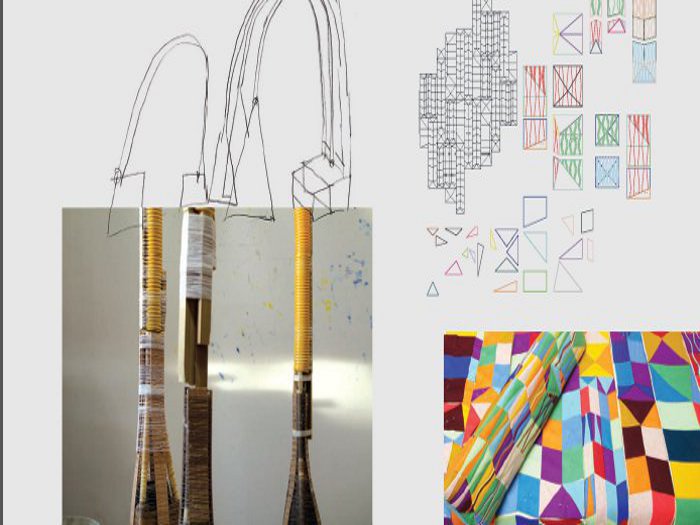
With his show currently at the Gallery Libby Sellers (see Blueprint 332, January/ February 2014), Alvarez is keeping busy right now, and when I spoke to him the night before opening, he was still fi nishing o_ a few pieces for the exhibition. Like these, his work for Kvadrat is an extension of his thread-wrapping investigations, which he is intent on pushing to the very limit. For Milan he's using the material on an architectural scale in the shape of three arches just over 2m high: 'I've been doing things that correspond to the human body in scale such as furniture, stools, chairs and some lamps, and I wanted to expand the size. It's something I've been thinking about quite a lot so when this material was given to me for experimenting I knew it had possibilities. I have created these arches, the simplest suggestion of an architectural space that you can have inside.
'Usually I join solid pieces of material together with glue-coated thread. Now what I've done is wrap pieces of textile in tubes, like sausages of material, and to hold them together and hold the threads in place I decided to accentuate the adhesive rather than hide it.
'I started using textile paint and that has become part of the piece and explaining more about the process. We get the paint on our hands while we are doing it and then we move our hands and you can see the traces of the paint in other areas, so you see the traces of the making and in a way it's a more honest way of telling the story of making.'

BETHAN LAURA WOOD
(in collaboration with Laura Lees)
Guadalupe day bed
While in Mexico last year, Wood had something of an epiphany at the New Basilica of Our Lady of Guadalupe (1976, by architect Pedro Ramírez Vázquez) - a design one rather than the religious kind. She fell in love with the basilica's fenestration: a dramatic circular band of coloured glass, like a thick belt around the building. And that has become the starting point for her project, working with the embroiderer Laura Lees.
'I fell in love with the architecture of the basilica, especially the windows, and I really wanted to work on a pattern based on these windows at some point,' she says. 'Then when I got the samples of the fabric I just knew this was the right pairing, because the fabrics are so rich in colour plus it's a kind of material which behaves like a really high-quality felt and so lends itself really well to being embroidered and appliquéd.
'I took lots of pictures of the basilica's cast-glass windows - they are very three-dimensional. I used a mix of those images to create a new pattern, trying to keep a feeling of that 3D depth. Then I did a lot of line drawings from these until I developed it into a pattern that would repeat, before starting to work on it with crayons that matched the colours of the fabrics. Originally I planned to do it as a patchwork, but it worked better with appliqué techniques. I was introduced to Laura and asked her to work with me. It's quite a full-on project and it's taking us a lot longer than we expected!'


MAX LAMB
Smock
There's a tactile robustness to Max Lamb's work that, like many of the best designers, is informed by an obsession with materials and process. When he got his hands on Kvadrat's Divina fabric, given his highly furniture-orientated output to date he quite naturally started thinking along those lines, before his project evolved into his first-ever piece of clothing, a smock. He sees it as honest workwear, which he believes plays to the strengths of the material.
'I like to explore the properties and potential of all materials without prejudice, and fabric is no exception,' he says. 'Divina is typically an upholstery fabric and although I started by looking at the possibility of designing a piece of furniture, after receiving samples and working with the material, I began to appreciate that the quality of the woollen yarns and the felting process, applied after it has been woven.
'Designing my first piece of clothing, while maintaining consistency with my approach to designing and making furniture, has been the most challenging yet gratifying aspect of this project. Focusing on a product type previously unexplored revealed a set of questions and problems that have helped reinforce my approach to design and problem-solving in general. Why must one chair fit all people when clothes are available in a multitude of sizes to fit all body types and shapes? My approach has been the opposite, to design one garment that fits all, or at least most.'

PETER MARIGOLD
Jib
Peter Marigold's output is an unusual mix of the inventive, practical, personal and artistic. He has a documented love of the unusual, particularly when it comes to mass-produced objects that haven't come out as planned. In this project, he has addressed mass-production (using his time-honoured 'favourite' material, wood), but gone to great lengths to make sure the unexpected isn't part of the finished project. And he also learned to sew: 'I was very curious about working with fabric, as it's something that I just don't do. I've actually always been incredibly bad when it comes to fabric. I'm quite used to working directly with more solid materials. I almost always prefer to make things myself and so I had to teach myself how to use a sewing machine, pattern cutting and upholstery techniques. It's always nice to learn a new skill and I'm really into sewing now! I made my two-year-old son Leon a wolf costume from all the little off-cuts.
'A lot of my previous work has leaned towards more artistic objects - things that would not be relevant for an industrially produced object, however I am very interested in those kinds of objects. I saw this as an opportunity to make something that could be mass-produced - that has that language - but at the same time has some qualities of personalisation. The stools are composed of four colours that can be brought together, almost like comparing fabric swatches. 'They are simple-looking objects - but there was a lot of time and experimentation spent to make them look as uniform as possible.'