
A life full of color: Michael Craig-Martin
Throughout the autumn, the Royal Academy of Arts is holding a retrospective on the long career of Michael Craig-Martin. David Trigg looks closely at the influential artist’s work.

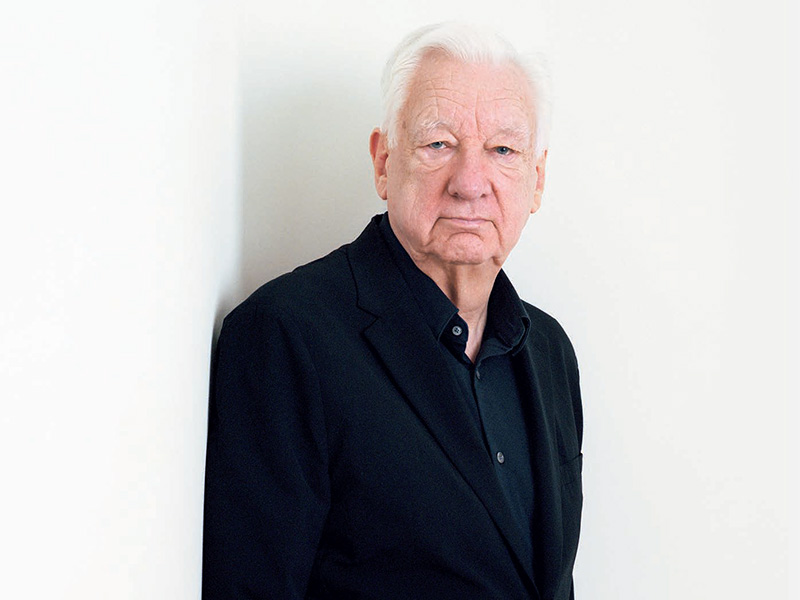
Portrait of Michael Craig-Martin. Photo Credit: Maxwell Anderson
OFTEN DESCRIBED as the godfather of the Young British Artists due to his mentoring of a precocious generation of students at London’s Goldsmiths College in the 1980s, Michael Craig-Martin is one of the most influential artists and teachers of his generation. A key figure in British art, he is celebrated for his wall paintings and architectural-scale installations that combine graphic line drawings and vivid colours to interrogate the relationship between objects and their representation. His vocabulary of recognisable forms – from buckets, torches, lightbulbs and shoes, to books, stepladders, mobile phones and laptops – appear in his works at varying scales, either isolated against flat monochromatic planes, or overlapping in complex constellations. Characterised by their precise draughtsmanship, these colourful forms feature in permanent commissions in buildings around the world and have appeared in temporary installations at numerous museums and galleries. This autumn, they are filling the Royal Academy of Arts (RA) in London as part of the largest retrospective of the artist’s work ever to be held in the UK (21 September – 10 December 2024).

Michael Craig-Martin, Untitled (papercup), 2014. Acrylic on aluminium, 122x122cm Gagosian, London © Michael Craig-Martin Photo: Mike Bruce. Image Credit: Gagosian
Craig-Martin was born in Ireland and spent his formative years in the US, studying at Yale University School of Art and Architecture before moving to London in 1966, where he has lived ever since. As an artist, he has made a career of subverting the ordinary and making the familiar seem strange. His early experimental sculptures, several of which are displayed in the RA exhibition, incorporate various everyday objects. On the Table (1970), for example, comprises four metal buckets of water that serve as a counterbalance to the suspended table top on which they stand. One of his most famous works from this period, An Oak Tree (1973), consists of nothing more than a glass of water on a shelf and an accompanying text in which he attempts to convince the viewer that he has in fact transformed this humble object into an oak tree, purely through his intention. Representing the culmination of his conceptual work, the humorous piece expresses the notion that belief fundamentally shapes our experience of art. ‘You either believe in a work or you do not,’ he has said.
 Michael Craig-Martin, Eye of the Storm, 2003. Acrylic on canvas, 335.3x279.4cm Collection Irish Museum of Modern Art, Purchase, 2005 © Michael Craig-Martin. Photo: Prudence Cuming Associates. Image Credit: Gagosian
For Craig-Martin, An Oak Tree represented a ‘full stop’ in his practice, after which he turned away from ready-made objects to their pictorial representation. Another section of the RA exhibition reveals how a renewed interest in drawing gave rise to his largescale wall drawings of everyday household items, executed in black tape with the aid of overhead projectors (each object was initially drawn freehand in line and traced onto drafting film). The drawing style is deliberately anonymous: ‘My initial idea had been to remove my hand from the drawing process in order to make a representation of an object that was as ordinary as the object itself,’ Craig- Martin has explained. All of the objects he chose to represent had been designed and manufactured and were fundamental to daily life yet were so commonplace that they had essentially become invisible. By making them the subject of his art, Craig-Martin encourages viewers to see them afresh, while his various juxtapositions create numerous associations and threads of meaning.
 Michael Craig-Martin, Untitled (corkscrew), 2014. Acrylic on aluminium, 122x122cm Private collection © Michael Craig-Martin Photo: Mike Bruce Image courtesy of Gagosian. Image Credit: Gagosian
 Michael Craig-Martin, An Oak Tree, 1973. Assorted objects and printed text, 15x46x14cm Courtesy the artist © Michael Craig-Martin. Image Credit: Gagosian
 Michael Craig Martin, Sea Food, 1984. Steel rod and oil paint on aluminium, 228.6x172.7cm Waddington Custot, London © Michael Craig-Martin. Image Credit: Gagosian
Showing no signs of wear or damage, his objects exist in what he describes as ‘a philosophically defined space somewhere between the particular and the general’, an essentially utopian vision of the world where nothing ever seems to be damaged or spoilt. Over time, he built up a large vocabulary of motifs, which he repeated and adapted to numerous spaces and situations. Although he had a deep love for colour he felt unable to use it in his work for many years. ‘Colour frightened me,’ he has written. ‘For my generation of the 1960s, it represented all that we sought to avoid: empty formalism, banal self-expression, the decorative, the arbitrary, the indulgent.’ The turning point came in the early 1990s when he began exploring the possibilities of paint in his practice. For a 1993 exhibition at Galerie Claudine Papillon in Paris, he made the bold decision to paint the walls of each room a different vivid colour: pink, turquoise, blue, yellow, green and red. Onto each of these he added two of his objects, painted life-size and in more or less naturalistic tones. ‘The effect of moving from room to room was overwhelming,’ he said. ‘I could see for myself the emotive power and sheer impact of intense colour.’
 Frank Lloyd Wright, 2017. Courtesy the artist and Cristea Roberts Gallery, London © Michael Craig-Martin
 Ronchamp, France, 2017. Courtesy the artist and Cristea Roberts Gallery, London © Michael Craig-Martin
 Guggenheim, New York, 2017. Courtesy the artist and Cristea Roberts Gallery, London © Michael Craig-Martin
Working in this way unblocked something for Craig-Martin. He found that painting his drawings in intense colours gave them an unusual emotional charge and it has since become the defining aspect of his work. The flat colours, which are chosen intuitively, do not describe an object naturalistically; there is no attempt to depict the play of light or shadows. Instead, they emphasise its physical presence by describing the difference between one material and another. ‘It was only when I started making these site-specific room installations that I realised it was necessary to embrace rather than reject the arbitrary and decorative aspects of colour in order to use it effectively,’ he has explained. ‘As soon as I relaxed about the arbitrariness of the colour, I started to discover complex internal considerations in each room and each painting that directed my choice.’ His whole-room painting installations are treated as site-specific and each one responds to the character of the building in which it is created. Visitors to the RA will see how Craig-Martin has engaged with the architecture of its Central Hall, transforming the space with his vibrant designs.
 Michael Craig-Martin, Street Life, 2009, Woolwich Arsenal DLR. Curated by Modus Operandi © Alan Williams, www.alanwilliamsphotography.com. Image Credit: DLR
With a lifelong interest in architecture, Craig-Martin has taken every opportunity to work professionally with architects and architectural projects. Over the years he has collaborated with internationally renowned firms such as Herzog and de Meuron, David Chipperfield, John Pawson, and Sauerbruch Hutton, creating large-scale permanent commissions in buildings around the world. ‘I have no interest at all in making decorative add-ons,’ he has said. ‘It is always my principal aim to make such works engage as seamlessly as possible with the architectural space in such a way that it is not possible to think of them separately.’ This is especially true of the Stirling Prize-winning Laban Dance Centre (1997–2003) in Deptford, London, designed by Herzog and de Meuron in collaboration with Craig-Martin. He was initially invited to work on the project as a consultant, providing advice on the use of colour throughout the building. His involvement soon grew and he became involved in all the principal discussions regarding the complex design issues involved in the project.
 Michael Craig-Martin, Street Life, 2009, Woolwich Arsenal DLR. Curated by Modus Operandi © Alan Williams, www.alanwilliamsphotography.com. Image Credit: DLR
The exterior of the building is made from a double skin of semi-translucent polycarbonate panels, which are coloured with a palette of magenta, green and turquoise to Craig- Martin’s specifications. During the day, these plastic walls offer glimpses of dancers as they move around inside the building. At night, the centre glows with the artist’s bold and playful colour scheme, which governs the rhythm and orientation of the building. The interior, designed to evoke an urban streetscape, features corridors and circulation spaces painted with his intense hues, which are intended to lift the spirits of the building’s users. Conversely, the colour palette of the dance studios is a neutral grey, white and black. The lobby is dominated by a huge wall drawing featuring the artist’s trademark objects rendered in both black and white and colour.
In a departure from his familiar imagery, Craig-Martin explored his love of 20th-century architecture in the 2017 print series Design and Architecture, in which iconic modern houses by renowned 20th-century architects are paired with an interior design classic that they also created. Le Corbusier (2017) features a frontal view of the eponymous architect’s Villa Savoye (1928–1931) on the outskirts of Paris. Rendered in Craig-Martin’s signature pared-back style, the building’s sleek white concrete has turned bright blue with a lurid green interior. It is presented alongside the famous LC4 Chaise Longue of 1928, which is similarly recoloured in orange and blue. A related series, Plan and Elevation, features colourful elevation renderings of landmark modernist structures, including Frank Lloyd Wright’s Solomon R. Guggenheim Museum in New York City and Le Corbusier’s Notre- Dame du Haut in Ronchamp, France, each of which is paired with a plan view of the building.
Craig-Martin’s interest in architecture is evident in the way his public artworks interact with the spaces they occupy. Characterised by their accessibility and ability to transform ordinary spaces into sites of artistic and communal engagement, these works have brought his art to a broader audience. One of the earliest, in 1975, was the result of an invitation from the Arts Council to propose a public sculpture for the facade of the civic library in Margate. He had recently started working with neon and suggested a simple light sculpture of an open book with turning pages. To his surprise he won the competiton and the neon was installed over the front entrance like a sign beckoning passersby into the library. However, the library staff had little interest in it and the neon was rarely switched on; the piece fell into neglect and after the building was demolished Craig-Martin wondered if anyone had even noticed it. Years later he was speaking with the artist Tracey Emin who had fond childhood memories of the piece. In 2011, the new Turner Contemporary gallery, designed by David Chipperfield, was being completed in Margate and Craig-Martin was commissioned to remake the sculpture for the gallery’s foyer, where it greets visitors to this day.
The open book motif was also used in 2000 when he collaborated with Sauerbruch Hutton on the conversion of a seven-storey building in central Berlin to accommodate the HQ of the British Council in Germany. Here, above the sinuous shelving of the first-floor library, is the artist’s lively ceiling painting of books; visible from the street below, it injects a burst of colour into the dark wood interior space. More prominent is the 2017 public mural Folkestone Lightbulb, which was commissioned by the Folkestone Triennial. The image of an energysaving bulb appears like a beacon above the junction of two of the most important streets in Folkestone’s old town: Tontine Street and The Old High Street, at the gateway to the Creative Quarter. ‘I always look for something that has some sense of appropriateness to the circumstance and also something that visually makes sense in terms of its location,’ Craig- Martin has explained. The form of the bulb satisfyingly picks up on the curving facade and spiralling architecture of the building on which it is painted, while conceptually suggesting ideas about sustainability and moments of inspiration (i.e. the ‘light bulb moment’), which are the essence of the urban regeneration project in the seaside town.
One of the artist’s largest UK public artworks is his 2009 Street Life design for the two-storey staircase of the Docklands Light Railway (DLR) Woolwich Arsenal station extension. The piece was commissioned as part of DLR’s public art strategy curated by Modus Operandi, and was the first time that he had worked in ceramic. The tiled artwork depicts a series of vibrantly coloured everyday objects including a milk carton, bunch of keys, umbrella, mobile phone and a wristwatch, all rendered at the same scale so that each carries equal importance. Craig-Martin worked closely with Mike Hornsby from Manor Architectural Ceramics to produce the work and each tile was individually screenprinted. ‘A public work of this kind allows an artist to speak directly to an audience that might never go to a gallery or museum,’ he said. ‘A station is not itself a destination but a place to pass through to go somewhere else. But many of its users will pass through it twice a day. I particularly hope this artwork will provide a stimulating note to the start and end of their journey over the years.’
With its distinctive blend of conceptual rigour, formal precision and aesthetic vibrancy, Craig-Martin’s intensely visual work has had a profound impact on contemporary art. His engagement with architecture and public art projects demonstrates a remarkable ability to transcend traditional artistic boundaries with works that resonate with a wide audience. In showcasing the broad repertoire of his 60-year career, the RA’s ambitious exhibition seeks to capture his innovative spirit, demonstrating how this pivotal figure of British art continues to delight, stimulate and inspire.