
Lenbachhaus Museum in Munich reopens after renovation
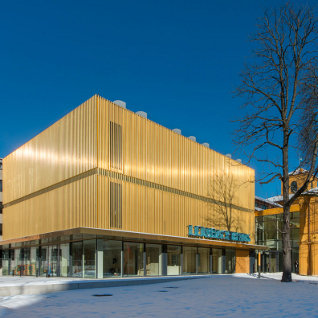
The Lenbachhaus Museum in Munich, Germany has reopened after completion of a major renovation project led by Foster + Partners that transformed the experience for visitors.
Built in 1891, the museum lacked the facilities to cater to a growing audience of 280,000 visitors a year. The renovation project has transformed a complex sequence of spaces of different periods into a unified, legible museum that is accessible and open to all.
As part of renovation, the museum’s historic buildings were restored and exhibition spaces were increased with the addition of a new wing, which enhanced the viewing experience for the ‘Blue Rider’ collection. The remodelling has also created a new entrance and social spaces, including a restaurant, terrace, education facilities, and a full-height atrium.
Under the renovation project, a 1972 extension has been removed to reveal the wall of the original villa, which has been restored in ochre render. The new building has been designed as a ‘jewel box’ to showcase the treasures of the gallery. It is clad in metal tubes of an alloy of copper and aluminium, with its colour and form designed to complement the villa’s rich ochre hue and textured facades. The different historical elements are then unified along Richard-Wagner Street by a new gallery pavilion, containing two levels of exhibition space.
As most of the art works of the museum were painted in ‘plein-air’, indirect natural light has been deliberately drawn into the upper level galleries to create the optimum environment for their display. A new entrance has been created adjacent to the restaurant, accessed via a new landscaped piazza to the east of the museum.
The new social heart of the building is a top-lit atrium, which features ticket and information desks, access to a new temporary exhibition space on the ground floor, and a grand, cantilevered stair to the upper level galleries. The top-lit atrium is scaled to accommodate large-scale works of art.
During the day sunlight infiltrates inside through a long, slender opening at roof level and horizontal louvres cast, changing patterns of light and shade within the space.
As well as repairing the fabric of the existing buildings, one of the main aims of the project has been to improve the museum’s environmental performance. A water-based heating and cooling system within the floors has been implemented. Furthermore, rainwater is also collected and recycled while lighting has been replaced and upgraded with low-energy systems.