
La Scala - Curtain up on Magic
Swiss architect Mario Botta faced a storm of criticism following his 2004 work on restoring La Scala Milan. Despite this, he went on to carry out another round of improvements – and this time the results were received favourably

IT WAS RATHER like the comedian Bob Hope. For a decade he was consistently and even irresistibly funny, in a way now hard to analyse. Amputated abruptness was Hope’s speaking style, mixed with a bemused have-I-got-thisright? curiosity – the wise guy who knows what he doesn’t quite get. I saw Hope at some very big show: he came on, shiny suit, ‘Thanks for the Memory’ was, as always, playing, he stood there, smiled, and told a joke. Nobody laughed. But gags die, humour doesn’t. A master of timing, he then proceeded to rip the place apart for 20 minutes – 2,286 people were in stitches. It was the London Palladium, and he owned that stage. Rapid fire, unstoppable, energetic, a feint at courage here, the rueful confession of inadequacy there, it was an all out onslaught of humour. Then he came to the end of his set, and somehow merged his final tale back into the first joke and got a laugh on it. And everyone knew they had been had. They all laughed. Genius.
 The building is located in the Piazza della Scala square in the centre of Milan. Image Credit: Marco Brescia © Teatro Alla Scala
Thanks for the memory. Indeed. Now, when in 2002 Mario Botta was hired to restore La Scala Milan, by 2004 the result was a warning to anyone who meddles with a myth. Everyone hurled abuse: the press, the politicians, the public – apparently, the acoustics were severely damaged, the appearance was irredeemably changed, the orchestra pit was destroyed, the whole thing was illegal, it had not been approved by the city council, it had all been carried out in secret, what had been thrown away was irrecoverable. The complaints kept on coming.
This was not the first time the theatre had undergone radical repairs since it was rebuilt following a fire in 1776, to a design by Giuseppe Piermarini in 1778, but for many people the renovation was ‘the end’. For someone renowned for designing places of worship, Christian, Jewish and Muslim, it was as if Botta did not have a prayer. Standing inside his most perfectly designed and constructed sacred spaces, no matter how small or substantial they might be, architectural space could indeed seem to dissolve, leaving light, and even, for the believer, God. This is what Bramante and Le Corbusier were trying to achieve. But at La Scala, Italy’s, and arguably the world’s, most revered opera house, offstage passions had risen to heights seldom seen in a place of worship, and unseen in the theatre. As far as the critics were concerned Botta needed more than the power of prayer if he was to ever finish the project.
 A 17-storey structure, six floors of which are underground, has been added parallel to La Scala on the Via Giuseppe Verdi. At the base of this tower is an orchestra practice room, and on top is an airy dance studio. In between are new offices, storage and rehearsal space. Image Credit: Brescia/Amisano © Teatro Alla Scala
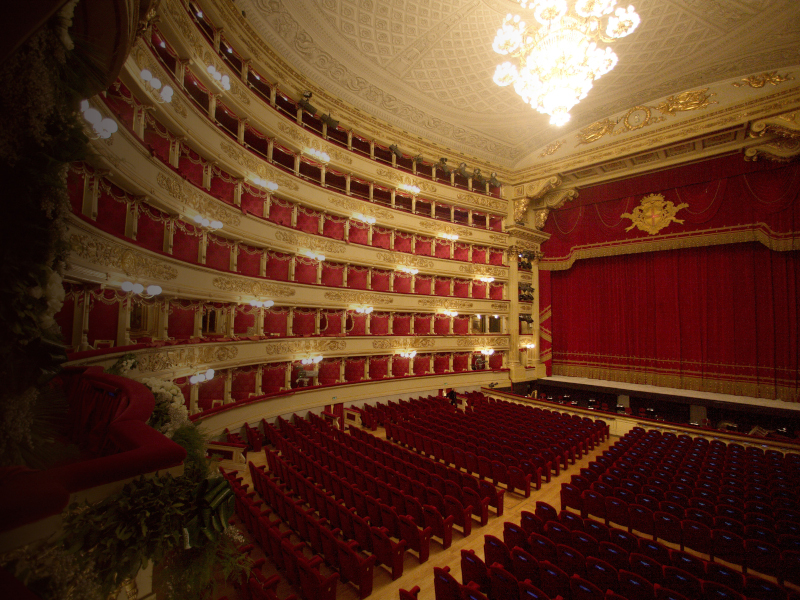
Should you pay £3,000 for a seat it has to be worth it – albeit just to enter that riot of red velvet and gilt is very exciting. La Scala has a special place in the history of music and the culture of the world. Ever since it was founded, under the auspices of the Empress Maria Theresa of Austria, to replace the Royal Ducal Theatre, it has remained the appointed place of Italian opera seria, with many of the greats first being performed there. Its list of greats includes conductors, the most renowned singers, the most feted ballet dancers, and the most remarkable theatre directors. This was always the place to make one’s name. So if Botta was going to hold on to his reputation he would have to redeem it here.
 Ballet dancers Nicoletta Manni and Timofej Andrijashenko performing at La Scala. Image Credit: Brescia/Amisano © Teatro Alla Scala
Ventures of this kind are notoriously risky. Creating a dialogue between the 18th-century and modernity is not easy. And a place of dreams and illusions, a space for adventure and collective imagination, is not a project for everyone to undertake. An opera house can mean anything from a custom-built laboratory-clean factory block with an auditorium like a posh cinema to a building originally intended as a music hall over a 100 years ago. Somewhere in the middle are the grand opera houses, the legacy of opera when it was the sport of royals, built as public monuments and given pride of place in the centre of capital cities. They were built mainly in the 1850s when the production of opera was a leisurely affair and when the position of the arts in public life was much better understood. No-one fussed about the money required, whereas today they are pummelled and chivvied towards maximum productivity and minimum cost. Thus the intendant, as the chief administrator is known, has to get as many shows as they can on as possible, which is always far more than the number for which the house was designed. Added to which all the buildings are tinderboxes and every one ends up burning down at some stage in its history.
 Seating capacity was increased by 300. Image Credit: Brescia/Amisano © Teatro Alla Scala
La Scala is the mother of all opera houses. It stands as a monument to opera in Italian life – and life is opera, as every Italian knows. Outside, it is statuesque and elegant, but once you go inside you sense the vibes of the thousands who have cheered, applauded and catcalled every production on its way before you. Whatever it is you sense, you are being conditioned for the opera experience, and the influence of the ‘house’ becomes important. Grand but not forbidding, you go through the foyers and up the staircases, your pulse beats a little faster, and then you sit down in exquisite comfort from where you can see who’s who and listen to the buzz and bustle of the scene. And if after this you can hear the first notes of the overture as clear as a bell then the place has done it’s stuff and it’s over to the opera. There is a problem with the numbers: because at the size of La Scala – today’s European standard at around 2,200 people – you cannot seat enough people to make it pay. If you go overboard and hold 4,000 like the Met in New York, you double the revenue but the audience cannot hear the music. Amplification is, of course, a sin.
 The musical director is said to be very pleased with the acoustics. Image Credit: Brescia/Amisano © Teatro Alla Scala
La Scala needed restoring, added to which a 21st-century theatre functions in ways unseen when this one was built: stage sets are different, offices, storage and rehearsal spaces are required, an airy dance studio and a room for the orchestra to practice both had to be provided, and all of this to be achieved while restoring original elements of the building – some of which had been hidden away for years. Not only had La Scala run out of space in which to perform, it required much greater flexibility, and whatever was to be done had to feel not only modern, but timeless, a collage and synthesis of different times, different materials, different needs, and functions. By the turn of the century, sets had to be moved by hand; the hydraulic machinery installed in 1938 no longer worked properly. There was too little space to store sets between shows. The list of problems facing the management was endless.
 The renovation and enlargement emerged on time and on budget, at around £100m. Image Credit: Brescia/Amisano © Teatro Alla Scala
Which makes it all the more amazing that the client came back for more and asked Botta to finish the job. And he accepted. The work completed in 2004 included conserving the opera’s interiors, restoring original elements that had been abandoned or hidden over the years, a much taller fly tower for stage sets, and a new elliptical building added. For the work undertaken between 2019 and 2023, a 17-storey structure, six floors of which are underground, has been added parallel to La Scala on the Via Giuseppe Verdi. At the base of this tower is an orchestra practice room, and on top is an airy dance studio. In between are new offices, storage and rehearsal space.
Having heard disaster proclaimed, the eventual result was that La Scala emerged from its own drama in remarkably good shape. The renovation and enlargement emerged on time and on budget, at around £100m. It all ended happily ever after. To the critics’ astonishment the musical director declared the acoustics fantastic, the mayor was happy, and the theatre’s general manager counted the takings. Continuity may be the leitmotif but the restored tiers of seating have an electronic libretto system on the backs that carry subtitles, while 15 boxes still display some original trappings, like frescoes and wall and ceiling mirrors. In a large second-tier box beside the stage, restoration work even uncovered a fireplace. Seating capacity was increased by 300, parquet flooring covered the main hall, and not only the stage but the entire backstage was rebuilt. Sophisticated scene-shifting machinery was installed, there were stage-size rehearsal rooms and new dressing rooms, the fly tower was 7m higher, and by digging 14m below the stage La Scala has obtained additional space as well as greater flexibility, and an adjacent Theatre Museum was renovated as part of the project. Botta’s surprisingly huge and coherent series of additions really work. He has pulled off the trick. The fat lady sang.
 Andrijashenko and Manni. Not only the stage, but the entire backstage was rebuilt. Image Credit: Brescia/Amisano © Teatro Alla Scala
Compared to the mismanaged modernisation of the Royal Opera House in London, which cost an extraordinary £400m (more than three times the price of rebuilding La Fenice in Venice), this was little short of a triumph. For Botta, as he was quoted saying last year, ‘architecture is always a sacred act, because it transforms nature and it represents our entire world. The architecture of sacred spaces is very close to the architecture of theatres or museums.’ Absolutely.
Botta is now 80. His work defies simple classification. He appears indifferent to style. The buildings are always dignified. They have grace. They can be sombre. There can be a touch of the austere. There are always subtle relationships. There is pure geometric manipulation. They will be formal. There may be hints at historicism. His urban structures may be very powerful, but they must always relate to their surroundings. There is often a lot of texture. He will always epitomise less is more. To someone as experienced as Botta, it might as well be ‘and for my next trick: La Scala Milan’ because the work of his firm really is a bag of tricks. And they are all brilliant, the more you look the more you see the man really is a magician. And having come in for so much criticism the first time around in 2004, it really has been magical the way Botta’s completion of his project at La Scala really works.
Born in the Ticino, the Italian-speaking canton of Switzerland, Botta dropped out of secondary school and after an apprenticeship in Lugano he went to Venice to study architecture where he met, among others, Carlo Scarpa, Louis Kahn and Le Corbusier. He even went to work with both Corbusier and Kahn for a while. He started his own firm in Lugano in 1970, and welcomed success early with some remarkable individual family homes designed over the next decade. In 2011, he moved his office to his home town of Mendrisio on the frontier between Italy and Switzerland. Nearer to Como than it is to Lugano, it is perhaps not surprising that in over a half a century’s existence the firm has undertaken so much work in Italy.
 Andrijashenko with Vittoria Valerio. Image Credit: Brescia/Amisano © Teatro Alla Scala
Milan may be a bit grey, tough, a bit ugly perhaps, but it has always been a byword for forward-thinking building – from the neoclassical glories of the world’s first shopping mall to modernist masterpieces galore, it has never stagnated architecturally; a scintillating mix of the medieval and the modern, culture and commerce, its architecture is a combination of the ornate, indulgent, austere, sugary-sweet icing gothic and fascist-classical imperial nostalgia. Arguably still one of the world’s capitals of design, this is where design is not a thing but a way of doing things – the culture of design is critical to its identity. And there are wonderful buildings by Stefano Boeri, Zaha Hadid, Daniel Libeskind, Arata Isozaki, Herzog & de Meuron, and OMA to admire.
Botta is probably the best of them. He has the last laugh.