
I.M. Pei - The Skyline's is the limit
With a retrospective of I. M. Pei’s career, using drawings, models, photos, film and archival documents, open in Hong Kong, David Trigg examines the Chinese-born US architect’s work

IN THE FIELD OF architecture, few names evoke as much respect and admiration as I. M. Pei (1917–2019). His seven-decade career left an indelible mark on skylines around the world, with buildings characterised by a fusion of modernist principles, cultural sensitivity and innovation. Best known for designing the great glass and steel pyramid at the main entrance to the Louvre Museum in Paris and the East Building of the National Gallery of Art in Washington, Pei also created cutting-edge commercial skyscrapers, such as the iconic Bank of China Tower, one of the most recognisable landmarks in Hong Kong. This summer, the city’s M+ Museum presents the first major institutional retrospective of the Chinese-born US architect’s influential career. Through original drawings, architectural models, photographs, films, and rare archival documents, I. M. Pei: Life is Architecture, which opened on 29 June and runs until 5 January 2025, reveals how his transcultural vision helped shape the built environment for the 20th and 21st centuries.
 J. Henderson Barr rendering of the Herbert F. Johnson Museum of Art (1968–1973) viewed from the Arts Quad, Cornell University, Ithaca, New York. Image Credit: M+, Hong Kong, Photographed With Permission Pei Cobb Freed & Partners
Ieoh Ming Pei was born in Canton (now Guangzhou) on 26 April 1917. His formative years were steeped in a rich tapestry of cultural influences. Growing up in China during a period of political upheaval, he witnessed first-hand the clash between tradition and modernity that would later define much of his architectural ethos. His father, a prominent banker, instilled in him a deep appreciation for art and culture, while his exposure to the works of Chinese gardens and temples ignited his imagination with a sense of spatial harmony and balance. After spending his teenage years in Shanghai and Suzhou, Pei began his architectural education in the US in 1935, completing his undergraduate studies at the Massachusetts Institute of Technology in 1940. He then went on to study for his graduate degree at Harvard, where he was exposed to the teaching of German modernist architect Walter Gropius, whose principles of functionalism and geometric clarity would leave an indelible mark on his design philosophy.
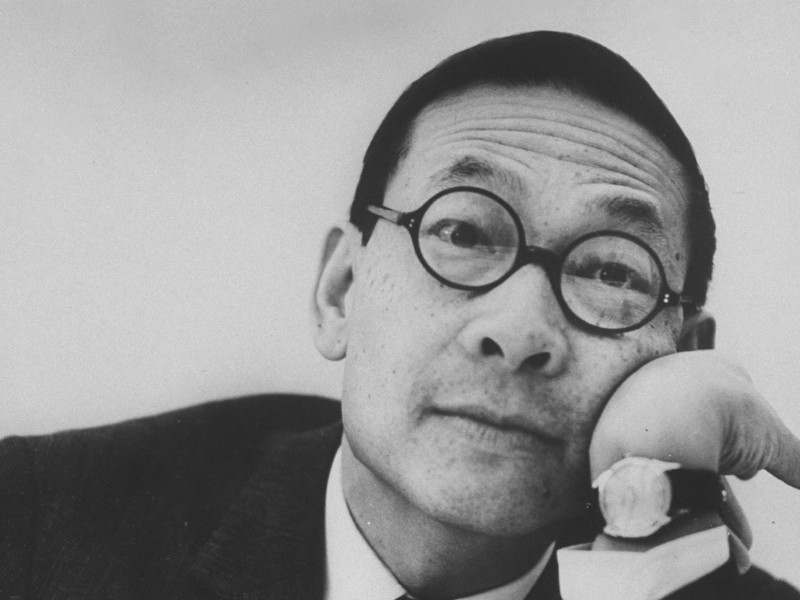
 I. M. Pei outside John F. Kennedy Presidential Library and Museum, Dorchester, Massachusetts. Image Credit: Ted Dully/The Boston Globe Via Getty Images
In 1948, two years after graduating from Harvard, Pei moved to New York to head the architectural division of Webb & Knapp. His commercial projects there included a prototypical experiment in low-cost housing called Kips Bay Plaza (1957–1962); one of Denver’s first post-war skyscrapers, Mile High Center (1952–1956); and a brutalist housing complex comprising three 31-storey skyscrapers in Philadelphia, Pennsylvania, called Society Hill (1957–1964). But Pei did not want to limit himself by working for someone else and so in 1955 I. M. Pei & Associates was informally established, becoming completely independent from Webb & Knapp in 1960. The new firm secured numerous important commissions, including the National Centre for Atmospheric Research (1961–1967) in Boulder, Colorado, the Everson Museum of Art (1961–1968) in Syracuse, New York, and the Cleo Rogers Memorial Library in Columbus, Indiana, (1963–1969). However, the commission that saw Pei thrown well and truly into the spotlight was the prestigious John F. Kennedy Presidential Library and Museum in Dorchester, Massachusetts, a building that took 15 years to complete.
 I. M. Pei explaining his proposal for Oklahoma City’s new downtown to one of the ‘city fathers’. Image Credit: The Oklahoman – Usa Today Network
In 1964, the year after President Kennedy was assassinated, Jacqueline Kennedy selected Pei over Louis Kahn, Philip Johnson, Gordon Bunshaft and Paul Rudolph to design the library dedicated to her late husband. Even though he was still relatively unknown, Pei seemed to her to be filled with promise and, despite his inexperience of monumental projects, she believed he had the imagination to realise her vision. However, political objections to the library’s proposed site in Cambridge delayed the building for years until a new site was found adjacent to the Harbour Campus of the University of Massachusetts Boston. Embracing the challenge with characteristic gusto, Pei conceived a design that married classical elegance with modernist innovation. The centrepiece of the bold, white geometric complex is a soaring glass pavilion serving as a beacon of hope and inspiration, its transparent walls embodying the optimism and promise of the Kennedy era. The library was officially dedicated on 20 October 1979, but for Pei its opening was bittersweet, since to his mind it represented a compromise of his original intentions.
 I. M. Pei walking up the stairs at the National Gallery of Art East Building, Washington, D.C. Image Credit: Marc Riboud/Fonds Marc Riboud Au Mnaag/Magnum Photos
Pei believed strongly that modernism could produce structures with just as much dignity, durability and popular appeal as the greatest of traditional buildings. He demonstrated this with aplomb when his elegant and innovative solution for the East Building of the National Gallery of Art in Washington D.C. was unveiled in 1978. Commissioned by the gallery’s trustees to design a new building to provide additional space for the permanent collection and temporary exhibitions, Pei faced the challenge of fitting the new structure into a trapezoidal-shaped plot of land while harmonising it with John Russell Pope’s neoclassical West Building, completed in 1941. The laborious design process saw I. M. Pei & Partners produce more than 150 drawings and models until, in a moment of breakthrough, the problem of the site’s irregular shape was solved by dividing it into two triangular forms. The triangle gave the building its leitmotif: a simple geometric theme with multiple variations appearing throughout the design. The angular structure of crisp glass and marble forms set around a triangular courtyard is considered one of Pei’s finest achievements. Critics praised it for its balance of monumentality and warm, welcoming character, hailing it as one of the most important American buildings of the era.
 Facade of Bank of China Tower (1982–1989), Hong Kong. Image Credit: South Ho
In 1979, Pei was awarded the Gold Medal of the American Institute of Architects, its highest honour. The accolade, coupled with the success of the National Gallery of Art building could not have arrived at a better time for the architect, who was still reeling from one of the greatest setbacks of his, or indeed any architect’s career: the near complete failure of one of his firm’s most prominent skyscrapers, the 60-storey, 790ft-tall John Hancock Tower at Copley Square in Boston. Just as the glass-covered building was nearing completion in November 1972, a window blew out, then another and another, littering the streets below with shattered glass. Nearly a third of the building’s glass fell out before the source of the problem could be identified, which was not a flaw in Pei’s design, but a defect in the new blue reflective glass, which prevented it from flexing in high winds. Lawsuits flew in all directions and the fight to clear its name nearly brought I. M. Pei & Associates to its knees. When the building finally opened in 1976, it attracted numerous awards, including the prestigious American Institute of Architects’ 25-Year Award, but it would be some years before Pei wholly won back the trust of American clients.
 Undoubtedly one of Pei’s most iconic and controversial works is the Louvre pyramid. Image Credit: Giovanna Silva
In 1982, Pei was invited to design the new headquarters of the Bank of China in Hong Kong, the bank which his father had once managed in the 1920s. The narrow, glasscovered skyscraper he devised is one of his most famous works in Asia, a commanding symbol of economic prowess and architectural innovation. Completed in 1989, the tower’s sleek, angular form rises 1,209ft above the bustling streets of Hong Kong, its asymmetrical profile reflecting Pei’s mastery of geometry and balance. Comprising four vertical shafts, it emerges from a large cube, reducing its mass, quadrant by quadrant and culminating in a single prism. Defined by prominent triangular and diamond shapes, the striking structure was a remarkable feat considering the compact site, restricted budget and extremely high structural demands of building high rises in Hong Kong, where wind load requirements were more than double that of New York City. Pei’s elegant solution was to use triangular frameworks, which transferred the weight of the tower onto the four main columns. This system not only allows high-velocity winds to be resisted, but reduces the number of internal vertical supports needed. As a result, the 70-storey Bank of China tower uses much less steel than similarly sized buildings.
 Chinese officials viewing a model of Fragrant Hill Hotel (1979–1982), Beijing. Image Credit: Calvin Tsao
Undoubtedly one of Pei’s most iconic and controversial works is the Louvre pyramid, which stands as an arresting symbol of modernity against the historic grandeur of the ancient museum. President François Mitterrand greatly admired the East Building of the National Gallery of Art in Washington and felt that something similar could be achieved in Paris where the Louvre was in sore need of renovation. Pei’s proposition of a glass pyramid in the centre of the Cour Napoleon to serve as a new main entrance faced fierce opposition from critics who claimed that it was sacrilegious to introduce such a modern design to the museum’s classic French Renaissance architecture. Pei countered the critics by arguing that his pyramid was simply an updated take on a traditional form that had an antecedent in the geometric work of the 17th-century French landscape architect André Le Nôtre. Despite Pei’s reasoned argument, it was Mitterrand who ensured that the project was brought to fruition. The new entrance, which invites visitors into a subterranean world of art and culture, opened in 1989 and within a few years came to be accepted and even admired by those who had spoken out against it.
 View of the faceted central structure, Museum of Islamic Art (2000–2008), Doha. Image Credit: Mohamed Somji
Pei was never one for staying within his comfort zone. One of his most unexpected commissions was the Rock and Roll Hall of Fame in downtown Cleveland, Ohio (1993– 1995), a museum packed with exhibits documenting the history of rock music, the artists, producers, engineers and other notable figures related to its development. Ascending above the shores of Lake Erie, Pei’s combination of geometric forms and cantilevered spaces is anchored by a 162ft tower, which supports what is best described as an enormous glass tent extending onto a 65,000ft2 plaza. Pei, who was not known to be a fan of rock and roll prepared for the project by visiting rock concerts with Jann Wenner, the editor and publisher of Rolling Stone magazine. His intention, he claimed, was to design a dramatic landmark reflecting the energy of the music and the stories that are told within. View of glazed facade towards the altar, Luce Memorial Chapel (1954–1963), Tunghai University, Taichung. Image Credit: Lee Kuo-Min
Another unlikely commission was the Museum of Islamic Art, in Doha, Qatar (2000–2008). As with the Rock and Roll Hall of Fame, Pei welcomed the commission as an opportunity to learn about a culture with which he was largely unfamiliar. He embarked on a pilgrimage to the world’s greatest Islamic architecture, including the Grand Mosque in Córdoba, Spain; Fatehpur Sikri, a Mughal capital in India; the ribat fortresses of Monastir and Sousse in Tunisia; and the Umayyad Great Mosque in Damascus, Syria. His greatest inspiration, however, was the 13th-century ablution fountain (sabil) of the Mosque of Ibn Tulun in Cairo, Egypt (9th century), one of the oldest mosques in Africa. Struck by the ‘austerity and simplicity’ of the fountain, Pei noted how the architecture came to life in sun, offering ‘an almost Cubist expression of geometric progression’. Melding elements of traditional Islamic architecture with 21st-century innovation, Pei’s design is built on a stand-alone island, some 195ft off Doha’s Corniche. Rising from the sea, the five-storey, 376,740ft2 building is characterised by a complex play of angular volumes. Built of fine materials, including cream-coloured Magny and Chamesson limestone from France, its geometric forms capture the play of light and shadows throughout the day. Inside is a soaring atrium with a stainless steel domed ceiling, from where visitors ascend a grand staircase to reach displays showcasing the full diversity of the arts of the Islamic world.
 Rendering of Tête de la Défense (1970–1971), Paris (unbuilt). Image Credit: Pei Cobb Freed & Partners
For the exhibition Life is Architecture, 11 of Pei’s built projects have been newly documented by some of the most exciting contemporary photographers working today, including South Ho Siu Nam, Naho Kubota, Kuo-Min Lee, Giovanna Silva, Mohamed Somji, Tian Fangfang, and Tomoko Yoneda. As their powerful images reveal, Pei’s designs transcend mere structures; they are manifestations of his unwavering belief in the power of architecture to shape society and enrich human experience. Visitors to the M+ Museum will also be able to view new models by local architecture students representing some of Pei’s most significant built and unbuilt projects, such as the Luce Memorial Chapel (1954–1963), a Christian chapel on the campus of Tunghai University in Taiwan, and the Hyperboloid (1954–1955; unbuilt), a 102-storey, circular tower with an hourglass profile that almost replaced Grand Central Station in New York. Through these and the many other objects on display, the M+ retrospective explores Pei’s unique practice in dialogue with social, cultural and biographical trajectories, showing that, for him, architecture and life really were inseparable.
 Suspension bridge extending from a tunnel dug through the mountains, Miho Museum (1991–1997), Shigaraki, Shiga. Image Credit: Yoneda Tomoko