
HKSAR Government opens City Gallery in Hong Kong
The Planning Department of the Hong Kong Special Administrative Region (HKSAR) Government has opened the Hong Kong ‘City Gallery’, which is designed by the London and Hong Kong-based designers MET Studio in collaboration with the Oval Partnership and the Architectural Services Department of the HKSAR Government .
Replicating the city’s planning and infrastructure as its theme on the design, the city gallery is located at 3 Edinburgh Place in central Hong Kong.
The City Hall Annex building has been renovated and adapted from office use to become a 3,200 square metre planning exhibition venue, with the 1,500 square metre gallery created from an extension of an existing gallery space on the ground floor.
With permanent exhibition areas, the venue also now includes a major introductory audio visual show space, which will double as an events and seminar multi-purpose hall. There is a further new space for thematic exhibitions on the ground floor and an integrated resource centre on the fourth floor. Vertical connections have been added in key locations to join the floors. Slots and view paths and openings have been added in unusual areas to create a dynamic and complex space for visitors to explore.
For social gatherings, the ground floor includes a spacious lobby. It also features moveable door panels, which can be opened up to accommodate a flexible area for temporary themed exhibitions as an integral part of the lobby when not in use. Although the four-storied exhibit begins on the ground floor, it then moves up to the third floor via a dedicated escalator, from where visitors come back down to the ground floor exit one level at a time.
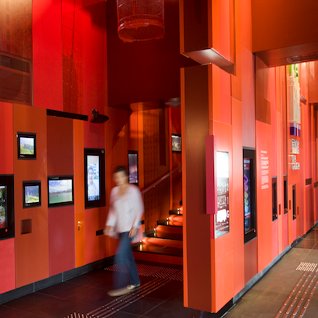
Exhibits on the ground floor help visitors orientate themselves, learn about the history and re-use of the building itself and provide a global city context for Hong Kong. The ‘Unique Hong Kong’ area of the gallery includes double and triples height spaces with image, audio and video content that challenges visitors to consider what Hong Kong is all about. A strong palette of red tones has been used throughout to contrast with the deep grey colours of the building to create a warm and welcoming entrance.
In order to add texture and local context, red duotone graphic details from famous local buildings have been printed directly onto some of the wall panels. The ‘Unique Hong Kong’ area deals with first impressions and the images. Sounds and Vox-Pop recordings used here all refer to well known locations, cultural icons and other reasons. It also features small boxes throughout, which visitors can open to discover images and audio clips. These include the classic special-event fireworks over the harbour but also reference, for example, classic canto-pop songs, local wildlife, the sounds of trams, excerpts from comedy films and people ordering lunch in Hong Kong style restaurants.
It also features an escalator from the ground up to the third floor, which forms a core part of the ‘Unique Hong Kong’ experience with video and audio effects, as well as intriguing views through to other spaces. Representations of classic Hong Kong neon signage have been added to create a distinctly local feel.
The third floor includes the ‘must-see’ introductory AV show, which covers the history of Hong Kong’s development from a sleepy island to a modern-day world city. The show focuses heavily on recent past, present and future developments of the territory, with elements including projection onto a full scale wall model of Hong Kong and a larger scale floor model covering the core harbour area. Video and images are projected at either side of the model on large screens that can be split into segments or used as one giant projection surface.
To allow flexibility for a multi-purpose hall with a 180-seat capacity, the floor model can be moved into a specially designed storage space during seminars and forums.
On the third floor visitors can also interactively discover who plans Hong Kong and how the public can get involved during consultations. In the same gallery area visitors can also interact with rolling map, which show how the coastline and skyline of the city have changed since the 1840’s. Selecting highlighted areas of the maps triggers fun audio visual animations explaining why certain streets were given their names.
In the second floor, the gallery features a link to the initial ‘Unique Hong Kong’ area. Visitors can see through an opening to the lower floors, including all the way down to the ground floor. This connection is enhanced by the further use of the red panel designs, which reference to some of the content themes. This ties in with a later section on the second floor where the content deals with transportation and the interior has a strong link to the Hong Kong MTR design, including a reclaimed MTR bench.
The ‘Strategic Picture’ area features a video introduction, together with a large interactive table that can be used by up to eight people at once. From this digital database visitors can find out all about the Hong Kong 2030 Planning Strategy. The design of the table has been developed as a back projection, partly to resolve the issue of the height restrictions, but also to add to the vertical connection between the floors. The glass projection surface can be seen from the ground floor and through opening on the first floor.
The final area of the second floor highlights the subjects of ‘Sustainable and Green Hong Kong’. Here renewable bamboo and recycled acoustic panels and materials have been used to provide an appropriate and comfortable environment.
The first floor features vox pops on heritage subjects and features Chinese brick tiles, old street signs and a reconstituted ‘wall tree’. The area also includes views into the ground floor void space and across the escalator.
The first floor features the ‘Living Environment’ exhibition area, which includes hands on exhibits using translucent glass back projection and augmented reality. Here visitors can explore some of the more technical issues involved in planning in an intuitive and engaging way. The ‘Heritage’ section of the Gallery again uses the Chinese brick finish in combination with wooden floors and mosaics. Inside the ‘Heritage’ debate chamber, visitors can sit on real Star Ferry seats and vote using interactive buttons at the end of each debate sequence.
The final area of the exhibition is entitled ‘Hong Kong Next Century’, which is designed with a philosophical approach. As no one can predict the future with any certainty, visitors are instead encouraged to make up their own minds.
The centre of the space features a cut-out map of Hong Kong, onto which visitors place building blocks and, inside them, a written wish for the future. The surrounding walls are designed to allow for a changing display of images, both on poster holders and on video. The Planning Department can also use this place to show local school ideas or a selection of fun posters.