
Helen Berresford

Since founding ID:SR, the interior design group of architecture practice Sheppard Robson, eight years ago, Helen Berresford has pioneered an approach she calls ‘activity-driven design’ and now has premier projects including the BBC’s new Northern HQ in Salford in her portfolio. She tells Jamie Mitchell about her approach
With an architect father and a ceramicist mother, it’s perhaps not surprising that Helen Berresford gravitated towards a career in design. Now head of ID:SR, the interior design group of London-based architecture practice Sheppard Robson, Berresford grew up in Bromley, Greater London, in the house her father, Ivor Berresford, designed in 1957.
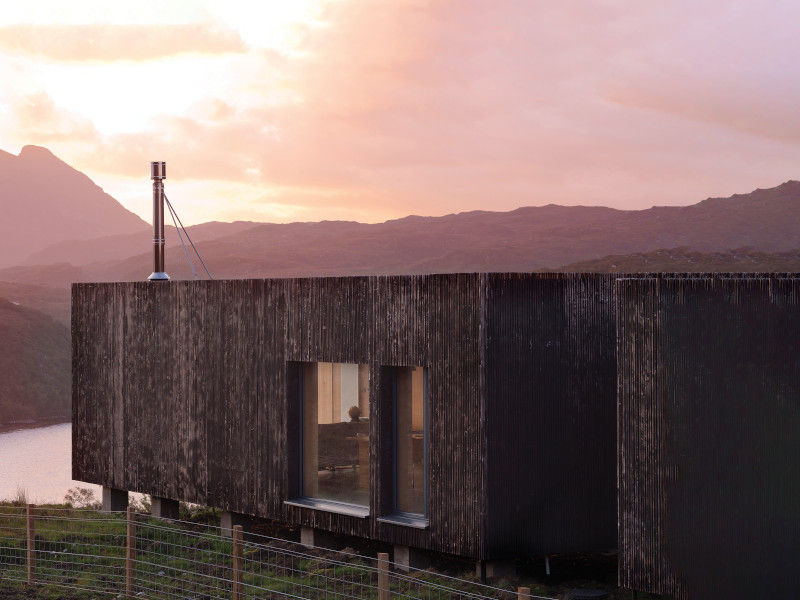
This cedar-clad bungalow, whose generous windows and sliding doors embody the optimistic spirit of post-war modernism, is now listed and considered one of the best-designed houses in the UK. During Berresford’s childhood the house was also furnished with her mother’s ceramics as well as furniture designed by Charles and Ray Eames. ‘Growing up in that beautiful Fifties, slightly Breuer-esque house, I had design all around me,’ says Berresford, ‘and I think that naturally influenced the way I felt about space.’
Berresford studied architecture at the Polytechnic of Central London (now Westminster University), before going on to the Royal College of Art, where her contemporaries included HMKM founder Christian Papa and architect Julian Cowie, as well as artists the Chapman brothers and milliner Philip Treacy. After graduating she worked for David Chipperfield Architects and Pringle Brandon among others before joining Sheppard Robson in 2002 and establishing the brand ID:SR two years later. Each of these experiences, she says, helped her see design and architecture in a holistic sense, an approach that is still central to the way she works.
‘Working with David Chipperfield, what really struck me was the design process, which was totally integral,’ she says. ‘We’d look at every element of the architecture, no matter how small. I feel that it’s the space inside as well as outside that matters and it’s getting a good balance of both that’s important.’
In her work for ID:SR, Berresford was determined to put people at the centre of the design process and pioneered an approach she calls ‘activity-driven design’. Exemplified by projects such as the BBC’s new Northern HQ at MediaCityUK in Salford, this means tailoring the design to the user, rather than taking a one-size-fits-all approach. ‘What we offer is interior design, but it’s actually so much more than that,’ says Berresford. ‘We begin each project by asking how a business works and how it wants to work. Then we do a lot of empirical calculations to help us understand what the people who work for that organisation need from their workplace.’
The level of organisation required is often staggering. A recent project for Newham Council in London’s East End involved relocating 2,500 employees from 26 buildings into one building with just over 1,600 desks. ID:SR created a variety of different work areas, promoting communication and collaboration between the council’s various teams. The idea is that the office functions as a community, which in theory will allow those who work there to better serve the community of Newham.
New technology and activity-based working mean the traditional model of the office, in which every worker has their own desk, is becoming outdated, and while it can be tricky to convince workers to give up their personal space, Berresford says the benefits are well worth it. ‘If every worker has a desk then you can guarantee that on average only half of them will be in use at any one time,’ she says. ‘You can’t just count people by desks any more; you have to be more complex in the way you organise people. But the great thing about that is that it can create a much richer environment to work in. Even some of our more traditional clients are realising that.’
Even so, Berresford says this approach isn’t for everyone, and that ID:SR’s role is to guide companies towards new ways of working, rather than pushing them. ‘The question is how do you give the client what they want,’ she says. ‘In the case of Newham Council we asked if they were traditional or forward-thinking in terms of their current space. They rated themselves as well-below average in terms of efficiency, and said they’d like us to help them get up to above average.’
When Berresford joined Sheppard Robson 10 years ago, the practice had an excellent reputation for architecture, but was less well-known for its interiors. Since then, her leadership has helped grow that side of the business exponentially. She says that establishing ID:SR as a strong brand was crucial. ‘When I started there was an interiors group, but it was perhaps seen as an add-on to the main business of architecture,’ she says. ‘I wanted to make interiors integral to the practice as a whole.’
The principles of activity-driven design can be applied to any type of business, from councils such as Newham to law firms such as Taylor Wessing, which asked ID:SR to represent its ‘people-first’ philosophy in the design of its London office. But the approach has been particularly popular with media companies. Alongside its recent project for the BBC, ID:SR is now working on projects for ITV and Channel 4, whose headquarters in London it is refurbishing. ‘At media companies like the BBC, Channel 4 and ITV people are now working on tablet computers and smart phones,’ says Berresford, ‘and that demands a totally different approach to office design. But the digital revolution is happening everywhere, blurring the boundaries between work and play.’
So will new technology spell the end of the office? ‘No,’ says Berresford, ‘but it will transform how we use the office, and indeed many of the environments we live, work and play in. The way people are using spaces is merging and the more we’re cognisant of that, the more opportunities there are for creative design in the workplace.’
This also means that the services of ID:SR will be more in demand than ever from companies wanting to take advantage of new technology and working practices.
‘I think that activity-driven design is something that we’ve evolved as a very particular service,’ says Berresford.
‘As a design practice we enter into the realm of management consultancy, albeit from a design point of view. I think the way we do that is something unique, and my ambition for the future is to keep driving that forward.’
This article was first published in fx Magazine.