
For the love of analogue
Digital-design evangelists should be wary of trying to replace the joys of real-time, analogue experience. Veronica Simpson gears up for a fight in the clutter corner

By Veronica Simpson
We took advantage of some Christmas holiday downtime to redecorate our living room this year. A trivial point to start a column with I know, but embarking on the first re-visioning of a key family room since we moved to our Victorian terrace in Peckham 15 years ago (as a young, child-free couple) brought with it an opportunity to engage with some very real issues about clean space versus clutter, about digital v analogue, and what makes a home a home.
With the walls bare and beautiful, we could have taken a decision to keep the room clutter free - a restorative musicmaking and quiet room in a house whose dynamic is changing quite markedly, as our two children become teenagers, intent on making their own noise, engaging with their own media and hanging out with their friends. As a life-long and committed music lover, I have an enormous collection of CDs and records and a pretty high- end music system to enjoy them on. These weren't going anywhere. We also have a decent array of design and travel books as well as a few decades worth of essential fiction. They were also staying put. Really, the clutter/minimalism debate was a no brainer: I love an analogue home.
Having gone to all the trouble of taking down and boxing up all those books, records and CDs, there was something slightly perverse about going through the tiresome business of putting them all back. But this time-consuming task was almost an act of devotion - an affirmation that these tactile objects have a real and important role in my life.
They are a map of our experiences - a record of so many pleasurable moments invested in the imaginative world of books and music, a celebration of the emotional and sensory adventuring that immersion in music, literature and the wider visual world brings. And they add a rich and meaningful patterning to the walls of our home.

To me, the ideal home needs to work on many levels. I like the idea that you can 'read' a home, however unfamiliar you are with the occupant. There will be a mixture of carefully arranged, aesthetically pleasing, objects, colours and textures - 'signifiers' of the occupants' taste or aspirations - and maybe a few slightly tackier or more whimsical items, such as souvenirs, gifts, finds, photographs, children's artistic offerings. A home should tell you something of the character and passions of its occupants as well as their tastes - taste, after all, can be artificially imposed. Where would the design world be if that were not the case?
Interior designers, better than anyone, understand how to insert layers of personality, sophistication and desirability in the blandest of spaces. But these spaces are fantasies - which is why they can work so well as bars, restaurants, hotels. Everyone wants a little bit of fantasy in their life, if only for the evening, or a week's holiday. But, to me, real homes - real lives - are filled with significant choices, contradictions, evolutions. The misshapen pottery class blob or the gurning and joyful holiday photograph should have a right to their wall/shelf space, as much as the covetable Bridget Riley print.
Yes, it is liberating that all our books, all our music, all personal photography can be carried around in small mobile devices - tablets, phones, laptops. It doesn't necessarily follow that we should strip our homes of the physical manifestations of these experiences and memories. The flatter and more twodimensional our daily experiences become (with our gaze flitting only between monastic or clutter-free homes and 'clean offices' to the glassy surface of our smartphones), the more I fear we might loose the art of looking.
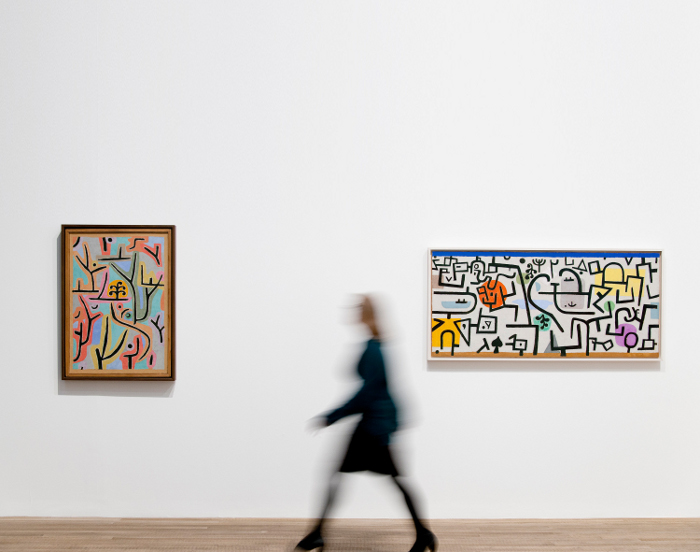
The wonderful Paul Klee exhibition at Tate Modern, which ended in March, was an exquisite lesson in looking - well, the clue is in its name: Making Visible. Klee's philosophy was that 'art does not reproduce the visible; rather, it makes visible'. Modern art, he argued, is not about reproducing what you know to be there, but revealing the 'many more other, latent realities' that a practiced eye could discern in a landscape, a city skyline or a moonlit bonfire. His often seemingly pixellated images are strangely appropriate for our digital times. But seeing these paintings in the flesh, what really emerged was the extraordinary care and attention that had been taken over each canvas, many of them densely engraved with scratches and lines beneath the oil paint; much meditation and contemplation lay behind the heightened reality Klee revealed in everyday scenes. He famously spent hours immobile in his studio - engaging in deep interior reflection while also studying his canvases - before placing a few brushstrokes in just the right place.
That kind of Zen approach to imagemaking seems as far removed from our frenzied, disposable, digital culture as the ancient wall paintings scratched on to the Chauvet caves in southern France (as immortalised in Werner Herzog's film Cave of Forgotten Dreams).
Luckily there are cultural markers which indicate the existence of a strong counter-trend in favour of the gritty, the grainy and the undigitised; from the blurry analogue delights of 'lomography' to the resurgence of drawing in design teaching and architecture CPD events; from the growing popularity of vinyl-only DJ nights to the awarding of architecture's highest trophy - the Stirling Prize - to an ancient castle, rendered reusable thanks to Witherford Watson Mann's elegant and respectful addition.
I for one will be happy to stand and be counted as an active member in this analogue-loving movement, along with every other un-airbrushed, gurning individual. The digital revolution ain't won yet.