
Focus: Education
Kevin Geeves looks at higher education venues that have to reflect the way students want to use them.

Words by Kevin Geeves
Education environments, especially those for higher and further education, are undergoing enormous change. Akin to the rapid evolution of workplaces, learning environments are having to adapt to the changing needs, expectations and priorities of the people who occupy them. Largely, but not exclusively influenced by technology, educational institutions are creating spaces that are transforming the user experience.
In an increasingly competitive market, they are acutely aware that ultimately they must be able to attract the best students, both domestically and internationally.
A truly global playing field
Just as employers are battling it out in a ‘war for talent’, higher education and academies are competing for students. This competition is fierce, and it’s global.
Students face fewer restrictions than workers when considering international opportunities. Study visas are more accessible than work permits, or a more permanent immigration status. So, while employers might be competing for talent across a city or country, universities are vying to lure students from across the globe. The lucrative foreign student has become a driving force for universities everywhere, and the UK is no exception.
Higher education is a valuable export and a vital component of the UK economy. A university in London is now not just competing with Manchester, but also Melbourne, Montreal and Milan. Its academic prowess must be buoyed by the attractiveness of its host city and nation. The institution’s facilities must be an integral component of its setting – the wider tapestry of its surroundings.
Great expectations for architecture and interior design
The expectations of, and aspirations for, architecture and design is being driven by local and international students alike, both of which now pay substantial tuition fees.
Expanded budgets are being provisioned for a greater investment in planning and fit-out for every aspect of a campus. Education providers are regularly finding themselves at the cutting edge of architecture and design.
From innovative way finding in large, complex structures to providing third spaces for people between lectures and formal study times, universities and colleges are aspiring to create open and transparent physical environments that people love to be in. And just like many forward-thinking companies, maximising productivity and wellbeing are pertinent factors. Even academic and administration offices of universities are moving away from traditional cellular spaces to more open plan landscapes. The lines between learning and working environments are most definitely blurring.
‘Corporate, but cool’ seems to be the underlying objective for both. Like a company’s HQ, the campus is a defining factor for the institution’s ‘brand’ – it has to look the part. Prestige and quality is often manifested in the architecture and interiors of the institution, becoming a beacon of iconic design in the local cityscape rather than the eyesores of yesteryear. Sustainability and green credentials are being taken into consideration for buildings and furnishings. Biophilic design, bringing the outside inside, even roof terraces and landscaped grounds – they are all part of the bigger picture and can help cultivate a sense of community.

Employability – the ultimate measure of success?
As the economy evolves, away from process-driven work, education systems and providers must reflect the needs of the imminent workforce. Preparing students for the jobs and workplaces of the future is influencing the facilities being provided. In a somewhat chicken-and-egg dynamic, colleges and universities are creating more ‘corporate’ environments, while companies are trying to provide less formal workspaces to reflect what new graduates might be more accustomed to.
The design of university buildings has an undeniable impact on the expectations of students who are soon to join the workforce. This may explain why institutions cite employability statistics of their graduates as a measure of success. With youth-unemployment crises across many advanced economies, being ‘work-ready’ can become an attractive benefit to students considering their options. If the physical environment is familiar, the transition will be smooth and the new generation are less likely to experience a culture shock.
And yes, of course technology matters – a lot
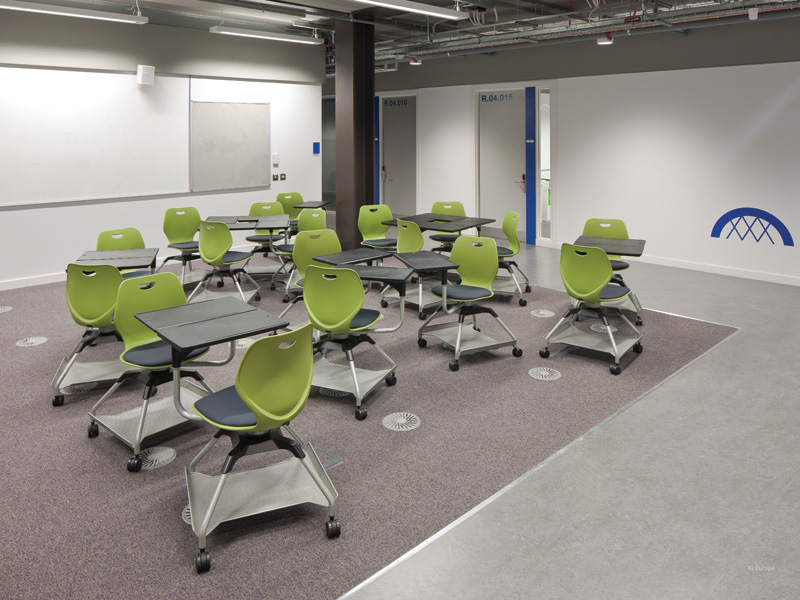
Of course, the impact of technology can’t be ignored. Younger generations of ‘digital natives’ have different expectations of teachers, facilities and content. Teaching methods and lesson content has evolved. The design and technology savvy students of today are aware of ergonomics and comfort. How students conduct research, study, learn and are assessed is constantly changing. The nature of their studies, like today’s world of work, demand more collaboration and flexibility rather than solitary, rote learning. Active learning – learning through experience rather than instruction – is transforming the physical space and the shape of furniture and fixtures within it. Nesting or stacking chairs, chairs on castors, or those featuring tablet arms are sought after to facilitate easy collaboration, and to create multipurpose spaces. Being able to immediately adapt to the lesson content is becoming a priority.
Mobility, flexibility and connectivity are intertwined. Cafes, libraries, corridors, gardens and student lounges are all now learning spaces – libraries are no longer just a warehouse of books, just as cafeterias are more than a social venue. Technology has allowed everything to be available at the touch of a touchscreen. Students expect to be able to pull up and do their work virtually anywhere, and are increasingly needing to do this in groups rather than in isolation. Future-proofed, low-maintenance furniture and interior design that supports this kind of activity can improve the student experience. Technology can no longer be an afterthought; it must be accommodated right from the start. Connections and plentiful charging points can enhance the effectiveness of classrooms and beyond.
By selecting furniture that provides somewhere to prop up books, tablet computers, laptops, papers and notebooks, a dull lounge can turn into a vibrant hub of activity.