
Fabricate digital fabrication conference 2014 - review
Alex Haw of art and architecture studio Atmos reviews this year's Fabricate digital Fabrication conference
Review by Alex Haw of Atmos
I recently returned from presenting our Mobile Orchard at the FABRICATE 2014 conference at the ETH in Zurich.
Its precursor, FABRICATE 2011, was organised by the Bartlett school of architecture three years ago to examine DigitalFabrication. Both conferences explored the bleeding edge of increasingly ubiquitous digital fabrication; both moved away from digital architecture as visualisation towards the intimate act of making - physically powered by computation.
The first conference mixed a star-studded cast with a choir of Bartlett and more local folk. It split its publication between academia and industry, though practice got slightly more pages. This time, academia predominated, merging more international voices with a core cluster from ETH and MIT - a weighting epitomised by the final keynote lecture, where Neil Gershenfeld (head of the Media Lab's Centre for Bits and Atoms) whizzed us through the history of digital fabrication - up to the present proliferation of fab-labs that he effectively initiated.
The two-day conference unfolded chronologically, from design to fabrication, near past to near future, sage to youth, implementation to speculation. It began with software - Autodesk's Robert Aish co-presenting DesignScript's deployment on a Bob Stern facade - and ended with quadcopters tentatively tying knots in the air.
The projects were generally extraordinary, treading a tightrope between fantasy and functionality, mixing the strange and the familiar. There was a clear collective focus on 3D printing and robotic fabrication (with the two occasionally combined) - a lusty thrust towards the future, yet with feet deeply rooted in the past.
ETH presented first and last, book-ending the days: co-organiser and master-robotic-mason Matthias Kohler introduced proceedings before handing over to colleague and session-chair Phlippe Block, reinvigorating traditional thin-shell Catalan timbrel vaulting techniques with Rhinovault; the conference ended with Gramazio & Kohler's research group's latest forays into flight-assembled architecture.

(c) Gramazio & Kohler, ETH Zurich

(c) Gramazio & Kohler, ETH Zurich
There were several other brick and masonry projects, including another Gramazio & Kohler group investigating robot-printed polymer formwork for high-rise buildings (Mesh-mould). Speakers Jelle Feringa & Asbjørn Søndergaard both presented at the last conference, which led to them forming the new startup Odico; this time they showcased their work with robots hot-wire cutting EPS masonry formwork, and theatrical, diamond-studded robotic band saws carving through ancient Italian marble.

Picture: Odico
Ronald Rael and Virginia San Fratello showcased their inventive hack of an aged 3D printer to print structures from clay or salt or rubber granules, or their own cementitious polymer. Barcelona's IAAC had teamed up with Joris Laarman's studio to explore mind-boggling anti-gravitational 3D printing, innovating a double-barrelled extruder of thermo-setting compound that the robotic arm immediately heated as it laid lines upwards in space. Amazing time-lapse video showed the studio's development of this tool to lay spot-weld dots - and slowly accrue elegantly-curving fibrous structural steel lines.
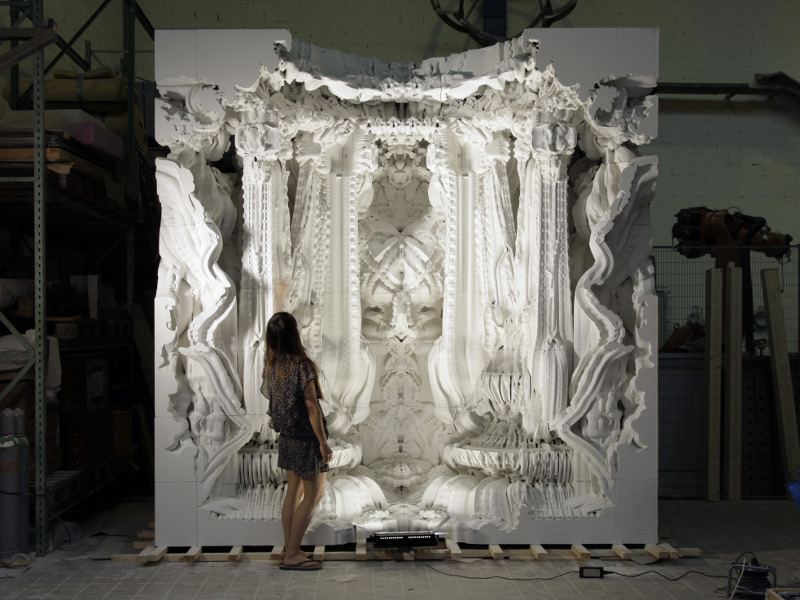
I presented as part of a session titled "Material Exuberance" - perhaps crudely summarised as an afternoon of art that followed a morning of architecture and preceded the next day's summit of academia. We felt slightly renegade - some of us still peddling our subtractive technologies (when the future's so clearly additive). The session concluded with Benjamin Dillenburger's fascinating presentation of his collaboration with Michael Hansmeyer (both also from the ETH) on their Digital Grotesque - an intricately-articulated computationally-generated grotto, what they describe as "the first human-scale immersive space entirely constructed out of 3D printed sandstone", with a refreshing blatancy in their appetite for aesthetics.
-2.jpg)
MobileOrchard, Finsbury Square, London. Photo: AlexHaw
The slight incongruity of their engineering sophisticated scripts to create hyper-symmetrical works resembling columnar, cupola'd, classical baroque echoed the slight bizzareness of our own conference project - chopping up a tree to re-make a tree, albeit an ergonomically-tailored one. Another notable contrast between us at atmos and the robots was our insistence on the flesh - the welcoming of bodies, the seduction with apples - that was otherwise ubiquitously invisible. The conference publication, so elegantly designed, had carefully removed all traces of our tree's inhabitants from every one of our photos (and I remember remarking how lucky we'd been on our photoshoot - since everyone who turned up was so good-looking). It seemed deliciously pertinent that in a post-conference bar I got cornered and semi-seriously accused of pornography - for showing a film of friends simply relaxing on the Orchard in their summer best.
.jpg)
The Mobile Orchard at night. Photo: Alex Haw

Digital Grotesque by Benjamin Dillenburger and Michael Hansmeyer
I was generally struck by three issues:
Firstly, it seemed that so much of the work was, almost unconsciously, still preoccupied with that most subtly 'additive' of techniques, drawing. Drawing a hot wire through foam or sawing through stone; drawing a filament through a motorised nozzle; drawing a line of plastic or metal through space and time, defying gravity, hoping to make a chair. Somewhere in our collective consciousness, some voice seems still to be suggesting that a giant arm is meant for making giant drawings.
Secondly, Spike Jonze's brilliant new film Her, in which a man falls in love with his phone's operating system, reminded me of our shifting relationship with the digital world, and how digital progress doesn't necessarily mean human progress.
The film charts a man's deep and ever-increasing infatuation with his sexy-sounding operating system. Humans, seemingly free, are actually imprisoned by their incapacity - wandering solitarily together, soullessly tethered to, and reliant upon, their digital devices. The film ends quietly (spoiler alert!) with the most benevolent 'rise of the machines' ever, as the operating systems evolve into a higher consciousness, and leave.
It reminded me of how our own current human ingenuity and knowledge seems ever threatened by lassitude and convenience; how extraordinary manual and mental skilfulness are, in our modern world, endangered species that we believe we can no longer afford to keep alive - and yet whose successors are yet no more economically competitive.
The spectre of 'slavery' hovered insistently at the wings of the conference - the indentured servitude of unpaid students on architecture's all-nighters gradually being displaced by unpaid (and as-yet insentient) robot slaves, some of whose masters were evidently finding them too expensive to continue to keep alive.
Thirdly, for all the ingenuity and invention required to master these machines, the use of robots still felt nascent and exploratory;youthfully playful, almost innocent. All those vast, powerful, agile automatons - so well versed in rapidly constructing extraordinary objects - seemed so often reduced to a crawl, their fantastic muscles slowly fiddling with the small stuff. Gorgeous and genius, but slow and small.
Mario Carpo ended his interview in the publication with a celebration of Le Corbusier - 'so important ... because... his ideas visualised a machine-made environment'. Corb fantasised about architecture merging with the highest levels of industry - ships, planes and the same car conveyor belt from which we've now inherited all those robots. It made me wonder whether the core unspoken task on our collective analogue hands wasn't actually one of reconciling design and craft, but of client and industry - and the need to get larger resources with larger teams to make larger things; to get academic endeavour commercially industrialised.
The Fabricate series brilliantly represents architecture's niche within the wider 'Maker-Culture'. One hopes that it will ultimately share that movement's zeal for social as well as technological revolution - and harness its distributed, bottom-up talent to achieve the scale of the architectural projects it so clearly aspires to; that all those beautiful, fabricated words will coalesce into larger sentences, paragraphs, manifestos and manifestations; that all its code creates a collaborative culture where all our individual, isolated bricks - our intricate local creations - will mesh into larger architectural systems and spaces.