
Client File - Dame Laura Lee
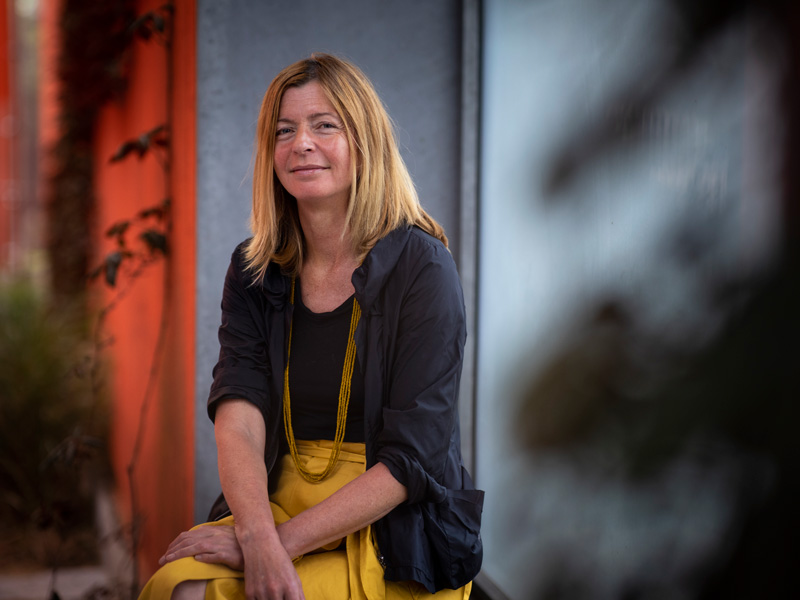
Dame Laura Lee chief executive of the cancer support charity Maggie’s, talks about the importance of architecture and design in creating supportive spaces for patients.

Words By Pamela Buxton
What is your role at Maggie’s?
I’m very lucky to be chief executive of Maggie’s, but that doesn’t quite describe my role, partly because I was the first employee and partly because my background was in nursing.
I witnessed the first client meeting between Maggie [founder Maggie Keswick Jencks] and Richard Murphy [architect of the first Maggie’s Centre in Edinburgh] and went on to be the client on all the others.
My job has evolved over the years, but because I’ve been here from the very beginning, I’ve stayed close to the things that I feel are most important at Maggie’s.
You knew Maggie Keswick Jencks well – what was her original vision for the centres?
She felt you should leave a visit to hospital feeling better than you arrived. But because of the strip lights, the waiting and the lack of views, you often felt worse. With the waiting, the complaint wasn’t so much having to wait, but about how you waited. It wasn’t necessarily about having access to the outside, but about being able to see outside to something like a garden or a tree.
She also wanted to create somewhere interesting where people would feel welcome and safe, and where they’d want to spend time. Having worked in NHS hospitals, I quickly saw how having a separate Maggie’s centre changed the hierarchy – it was the patients’ place, not the hospital’s.
 Maggie’s Royal Free by Studio Libeskind. Photo Credit: HUFTON+CROW
How important has architecture and design been to realising Maggie’s vision for supportive spaces for people with cancer?
The buildings actually deliver some of the care, by helping the care that the professionals who work in the centres are giving to penetrate in a deeper and more meaningful way.
We’ve learnt that it doesn’t take that much to make a difference – even little things like making the windows lower so that you can see out more are important. At Southampton, Amanda Levete sunk the building down so that there was an acoustic and visual buffer to the car park surrounding the site, and the impact of the garden outside was huge inside the building.
Did you have any experience of working with architects and designers before? What skills have come in handy?
I didn’t know anything about architecture and design – my world in nursing was nothing to do with the design world. But I liked a neat and tidy ward, with comfortable patients.
Being a client is about being committed to a project right to the final details at the end.
 The Rem Koolhaas site in Glasgow. Photo Credit: LILY JENCKS
What is your process for appointing the design team, and has this changed over time?
Maggie and Charles Jencks had great friends in architecture who were amazing, and when Maggie died in 1995, many of them wanted to do something in memory of her, so we worked with them [on some of the early centres]. We took our time – with Norman Foster, for example, we waited until we had the right site, in Manchester (2016).
We’re not looking for an architectural statement. We’re interested in their response to the brief – an architecture that makes people valued and feel safe.
We don’t hold design competitions. Instead, we are always looking at different practices’ work to find out who’s interesting, and who would get the emotional context of the brief. And when we secure a particular site, we think about who would respond well to that. At Barts, for example (2017), it was a very difficult site and we chose to work with Steven Holl, who had a great track record in dealing with difficult lighting conditions and working close to listed buildings.
We aren’t particularly looking for people who have track records in healthcare. Niall McLaughlin, who is designing our Cambridge centre, had done a wonderful project for people with Alzheimer’s, but we particularly liked his early work, which seemed a bit more playful. For us, a bit of humour is important.
It’s been wonderful and a real privilege to work with the architects and landscape designers we’ve worked with. They’re amazingly thoughtful individuals.
What qualities do you look for in a practice?
Being interested in what we do. It’s a long project – we’ll have to raise the money – so they have to be in it for the long haul. They have to have the commitment.
It takes a true collaboration to get a really good building. You need to have a trusting relationship between architect and client. It’s important that clients really listen to their architect.
You now have 24 UK centres in a variety of architectural styles. Were you looking for diversity of expression rather than a recognisable house style?
Charles Jencks had a very eclectic view about architecture, and I hope our body of centres shows that range. If they have anything in common, it’s that they’re all contemporary architecture.
What are the most challenging and rewarding parts of being a design client?
The designing part is always wonderful. One of the benefits of working with a new architect each time is that it’s fresh and new for them, and also for us. They make us think about what we do anew.
You have to learn how to work with different architects, which can be an adjustment. Rem Koolhaas (Glasgow, 2011) was super fast and the building is amazing – so tender. He got the design in a flash. Other architects take their time, and you need to allow that. If you rush the design process, you can end up with something that’s not right.
We’re currently working with Assemble (Kent). They’re a collective, so it’s a bit discombobulating. But we’re learning.
We’ve also learnt from experience that the more you can deliver the garden together with the building, the better the impact is.
You worked with Studio Libeskind for the latest Maggie’s at the Royal Free Hospital in London. How did that come about?
We ‘d been in conversation with Daniel and Nina Libeskind for a long time about doing a Maggie’s. The Royal Free (2024) was a very difficult site, a tiny wedge by a car park. It just felt like the right site and the right time to ask them.
What do you feel works particularly well at that building?
The musicality of the building is what I like – it doesn’t fight with the surroundings and it’s so surprising. It has very few straight walls – people feel enveloped and welcomed when they come in, and they often comment about the quality of light.
 At Barts, Maggie’s worked with Steven Holl. Photo Credit: NAARO
Do you think there is a better appreciation nowadays of the healing power of architecture in healthcare settings?
I think so. The ordinary person on the street does appreciate good design, although I’m not sure that’s acknowledged. But I do wonder who in government cares about the quality of civic buildings as places of pride and coming together – perhaps our best buildings are in the private and corporate world.
We keep doing the best we can with the budgets we’ve got, because we know how important the centres are to people. It’s a constant challenge.
Do you have any more developments in the pipeline?
We have quite a few centres in development, including Northampton (Stephen Marshall Architects); Cambridge (Niall McLaughlin); Kent (Assemble); Coventry (Jamie Fobert Architects); and Bristol (MUMA). And we’re doing lots of feasibility studies – there are 18 NHS hospitals that would like a Maggie’s.