
Camper’s Life on Foot: Zonzo, the city where you can get lost, and the wasting of time
Francesco Careri, founder of architecture collective Stalker and research network Osservatorio Nomade - that carries out walks in the ‘indeterminate’ or void spaces of the city - ponders the meaning of Zonzo, a city of flaneurs as described by Walter Benjamin. The text is taken from The Walking Society, the wide-ranging catalogue that accompanies the Design Museum’s exhibition on Spanish footwear brand Camper, entitled Life on Foot

Words Francesco Careri
All images courtesy Camper
Flânerie
In the early years of the past century, out of the sight of architects and planners, a new city began to grow within Old Europe - the city of 'Zonzo'. This was a city in which you could walk around and get lost, and where the first doubts about the promises of the Modern Age began to be harboured.
In Italian andare a Zonzo means 'to waste time wandering aimlessly' or to 'lose time'. It is used, for example, in phrases such as 'instead of working s/he "va a zonzo"'. 'Zonzo' is the city of flaneurs as described by Walter Benjamin, a time-wasting activity which could be seen under the windows or along the boulevards or passages in Paris at the end of the 20th century and fits perfectly within the context of those streets where artists roamed aimlessly, seeing the act of wandering the city as a form of urban art.
We can trace a line between the relationships built up between the visual aspects of the city and different experiences linked to walking - experiences and practices that have offered new ways of seeing those hidden transformations of the Western city, which we have decided to term as Zonzo. If in the first instance the zonzo-like wanderings of the flaneur were a way of creating anonymity among the crowds on the big streets of the new modern city, this activity soon changed into a search for other kinds of places, for zones which had, in some way, been missed by the modern world and which openly resisted that very project.

Zonzo became something elsewhere: a zone where the city hid its waste and where - in a process which in some ways was out of control - new urban spaces and new forms of living could be seen. Andare a Zonzo also took on the meaning of going to a zone - and it might be that the very word zonzo has an onomatopoeic relationship to the Italian word zona, and the Greek word zonnynai that means 'go around' or 'wander around'; this is a verb that is absolutely central to the language of the Athenian peripatetic philosophers.
In Paris, the 'zone' means those areas on the edge of the industrial city where even today there are flea markets, where chance is still a key factor and where you can still come across strange objects. And it is here, between the exterior and the interior periphery, that in 1927 George Lacombe shot his film La Zone, which tells the story of an area in continuous entropic transformation as in the image of an uninterrupted flow of rubbish on which an entire people fed itself.
Visits
It was precisely that zone which came to be seen as the symbolic place by those artistic vanguards who were looking for a new aesthetic practice through which they could experiment with the idea of overcoming art itself. Zonzo was an ideal place to build the basis for a kind of anti-art, to experiment with aesthetic activities that did not lead to objects which could be sold but instead to real experiences such as visits and walks in the city.

The walking in Paris described by Benjamin in the Twenties began to be used as a form of art which inscribed itself directly in terms of space and in real time without producing material works as such. The Parisian dadaists in 1921 started to elevate the flânerie tradition into an aesthetic operation centred on the city, by organising a first visit to the church of Saint- Julien-le Pauvre, 'a church which was little known, surrounded by a kind of terrain vague surrounded by palisades'. The aim of the visit was to pay attention to 'places which have no reason to exist': banal places where interventions could be seen as a kind of nomadism - without leaving any traces, or 'works'. This visit was one of the first urban happenings in the history of art.
Déambulation After this first step the dadaist group carried out a long series of déambulations in open countryside with chance movements between two cities, while later on the focus was increasingly on the city as an object - and this can be seen in the first surrealist novels of [André] Breton and [Louis] Aragon.

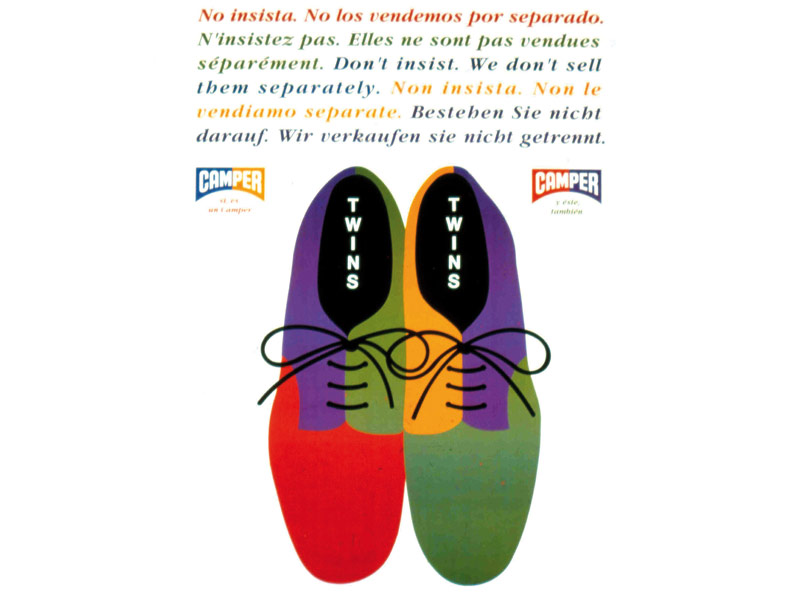
Camper poster, 2003
In Le Paysan de Paris, Aragon described the city from the point of view of a peasant faced with the dizziness of the modern world as provoked by the growing metropolis. This is a kind of guide to Zonzo, where the marvels of everyday life are found within the modern city, and where unknown and banal places are hidden from the tourist. During a noctural deambulazione, the Park of the Buttes-Chaumont was described as a place 'where the unconscious of the city is nestled'.
This was the first time that it was claimed that the city might have a dark side, an unconscious zone which had not been part of projects by planners and administrators. From these first deambulations came the idea to produce new forms of cartography, those influential maps based on changes in perception gained from moving through the urban environment.

Camper poster, 1986
Breton wrote about the possibility of designing maps in which the places that we like to visit are coloured in white, and those we try to avoid are in black, while the rest is in grey, representing areas which shift between attraction and repulsion. He proposed a street map where 'if we pay a little attention, we can see alternating zones of well-being and malaise, and we can measure the longevity of each'. This was also the beginning of a new kind of science: psycho-geography.
Dérive
The term dérive first appeared in the Formulaire pour un Urbanisme Nouveau, written in 1953 by the 19-year old Ivan Chtcheglov, alias Gilles Ivain, who, safe in the fact that 'the rational enlargement of psychoanalysis to the benefit of architecture is taking on increasing urgency', described a changing city with a continual variation in its inhabitants in which 'the main activity will be a continual drift'; 'This continual change of landscape [would] lead to a complete sense of loss' through neighbourhoods whose names corresponded to successive emotional states.

Camper poster, 1999
In 1956 Guy Debord wrote Théorie de la dérive, in which the next stage from the surrealist 'deambulazione' was made clear.
The dérive is a constructed operation which accepts the possibility of chance, but is not built on chance - and it has some rules. These are set out in advance, in line with psychogeographic mapping - and the extension of the area of enquiry can change from a street to a neighbourhood and can even reach 'a whole large city and its peripheries'.

Camper poster, 1983
The dérive must be undertaken by groups made up of 'two or three people who have arrived at the same level of consciousness, so that the meeting of minds between these different groups can help arrive at objective conclusions'. The average length of these events was defined as one day, but they could last for weeks or months, depending on the influence of the weather, the chance of taking a break, or the use of taxis for when people got lost.
New Babylon
The first city to take on Zonzo as a personal model was New Babylon, in the work of the situationist Constant [Nieuwenhuys]. This was a project which lasted from the end of the Fifties right up to the start of the Seventies.
New Babylon is a nomadic city - a utopia that was born from the acts of walking and getting lost, and that tells a tale showing how people on this earth could live in another way.

Camper poster, 1982
This is a new habitat for a new kind of nomadic humanity - free from the slavery of work and free from the slavery of a sedentary existence. The enormous quantities of models, maps, drawings and writings that make up the unbreakable space of New Babylon is a revolutionary project for an entire society that will one day return to its nomadic roots - a fascinating urban idea which anticipates the mega-structures of the Sixties - a political manifesto that intends to remind everyone they are free to move without borders and barriers.

When people no longer have to work, they will no longer need a fixed abode, and they can begin to move freely in space and to explore all the corners of the globe, and will have limitless time at their disposal in order to pursue their dreams - and working lives will become creative activities. Homo Faber will become Homo Ludens, as described by Johnan Huizinga at the end of the Thirties. That which is useful will give way to the most creative activity of all - games. Every art will start to work together in this future Great Game - the transformation of space that will call itself Unitary Urbanism. New Babylon will thus be a large-scale collective work, the fruit of the nomadic creativity of the neo-Babylonians, a new and free society which will start to build and rebuild its own space forever.

Constant's New Babylon was a complex infrastructural system made up by enormous urban sectors that covered the landscape like an enormous shapeless spider web in order to allow for continual migration towards new adventures. If you look in the folds and corners of our cities today you might think that New Babylon is already a reality. These new spaces abandoned in the Zonzo world present themselves as a New Babylon lacking in all kinds of mega-structural and hyper-technological features.
These are spaces that are difficult to read, which penetrate the consolidated city and show themselves in a way like that of a nomadic city that lives inside the sedentary city. This is a sequence of linked sectors that are no longer raised above the land, but immersed in the city. Transitional spaces have grown in Zonzo's folds, transformational landscapes which have continuity in time and space - seas covered by multitudes of people that are hidden from the city. The nomadic city lives in osmosis with the sedentary city; it feeds off its waste and offers in exchange its own presence as a new kind of nature.

New Babylon's adventures can be a useful way of thinking of those Zonzo zones which, in the Twenties, wanted to escape from the Modern project and that in recent years have started to question the contemporary project of the global, neo-liberal city.
Exhibition Design – Life on Foot
Jason Holley - Universal Design Studio
Camper has always been a compelling brand to us as it has proved to be a great patron of architecture and design, with an incredibly strong visual identity communicated consistently through all of its outputs, whether through product, campaign or store interior. It is a rare example of a brand that is an independent family-run business, which is rooted in a culture, but achieving an uncompromising and consistent global image.

Camper poster, 1977
At a time when many retail brands were creating identical store interiors globally, Camper was foregrounding the importance of place and of design in its environments, with each store having a unique concept and using different designers, both established and emerging. This individual approach to each location created a strong coherence to its identity, displaying a consistency of attitude, rather than a consistency of design.
This approach to a global roll-out was ahead of its time and something that many brands are currently pursuing as they move away from identical-looking global interior fit-outs.
The attitude that prevails through all of its outputs displays characteristics of lightness, play and humour, with a focus on the role of the unexpected, positioning Camper as the non-conformist.
The challenge for the exhibition was how to condense the company's 40-year history into one space while articulating these key characteristics. Translating this attitude into the exhibition environment started with the shoe itself, with the stories condensed into individual iconic shoes that speak of Camper's approach to design, making, production, sustainability and history.
We used Camper's 'Walking Society' as the starting point for our spatial concept. The Walking Society was a sort of anticampaign intended as a cultural statement about life in the Mediterranean and the importance of walking. This idea of walking, and of travelling through the exhibition, led us to the creation of a raised, folded ground plane, dissected by pathways that created a landscape through which visitors could wander. Conceived as a space for the modern flaneur, we have created moments of surprise and distraction to lead visitors through the space and reveal Camper's stories.

Material inspiration came from Camper's commitment to sustainability and from the use of recycled rubber tyres in the soles of the shoes. We chose a recycled post-consumer black rubber surface to clad the raised landscape, which will permeate the entire gallery space and provide the backdrop against which the content and graphics are transposed.
Taking its cue from the Walking Society, the second part of the exhibition is a survey of the latest design research related to walking. Envisaged as a contemporary and speculative physical consideration of what life on foot will mean in the future, as society responds to changing social, cultural and physical environments, the exhibition contains projects by artists, designers, and architects, all grappling with this theme but from different perspectives.
Overall, the exhibition landscape creates an uncompromising spatial and visual experience that encourages the visitors to wander, discover and speculate on the history of Camper and the future of walking.
Graphic Design
Kirsty Carter - A Practice For Everday Life
The graphic design for Life on Foot is intended to have an affinity with Camper - while not feeling too brand-heavy. To achieve this we've reinterpreted aspects of the Camper identity outside of their usual context, combining them with other elements to create a distinct visual and structural approach. The entrance uses the Camper bridge in a playful but subtle way, directing the visitor to focus on the feet of other people in the space.

Entrance to the Life on Foot exhibition at the Design Museum
The surface treatments throughout the show encourage a similar focus; for example, the famous Pelotas sole has been adapted into a large floor pattern, provoking visitors to think about their feet and the act of walking. This same motif is echoed in the round, coloured fixings used within the display - one of a range of playful touches and unexpected details that are incorporated into the design. The section titles of the exhibition take inspiration from traditional finger-post wayfinding systems, with the directional arms displaying key works and the structures also supporting section panels.
We devised a minimal display system than plays on the use of a 'line' that travels through the exhibition, guiding the visitor and creating a flow between the different thematic areas. Captions are slotted in to this 'line', and elsewhere modular shelving offers flexibility and the opportunity to display the exhibition in different venues in the future.