
Bar & Leisure Focus - Q&A: Shed
Bar & Leisure Toby Maxwell speaks to designers shaping enticing spaces, and we assess a few examples of projects that have harnessed uniquely creative ideas to set themselves apart in a highly competitive hospitality field

Edited by Toby maxwell
BARS, RESTAURANTS and other leisure spaces have had to navigate some very choppy waters throughout the post-pandemic period. The cost of living has stirred up a double-whammy of price-conscious consumers and rising overheads for all in the sector, making it more important than ever to deliver something special enough to shape priority destinations for customers.
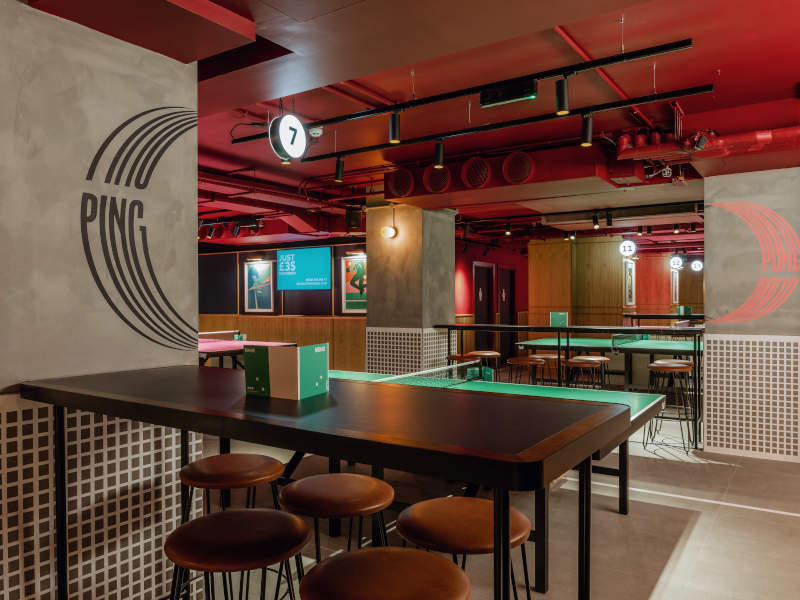
 State of Play Hospitality wanted to make a statement with a fresh design concept that stood out in the hospitality sector. Image Credit: Kris Humphreys Photography
Innovation remains as important as ever, but with a real understanding that investment in interior schemes has to do far more than just follow the trends or provide a note of curiosity for visitors. The role of interiors in defining the entire brand has become vital, and this demands a bold, coherent and distinctive creative vision that tunes in to the DNA of the business and its customers.
As well as speaking to some of the designers who are shaping such enticing spaces, we assess a few examples of projects that have harnessed uniquely creative ideas to set themselves apart in a highly competitive hospitality field. From a multinational burger chain utilising interior specification to help its environmental goals, and a bar dedicated to taking guests on a cosmic journey, to a ping pong parlour situated in one of London’s most iconic new developments, there are a wealth of remarkable projects that are striving to lead the way in differentiating and innovating in order to capture visitors’ imaginations.
Matt Smith, co-founder at Shed, on why delivering escapism is key to creating spaces that people really want to visit…
What is your own career background and what was the path that led you to working within hospitality architecture and design?
Although I graduated in interior architecture and design and then worked within traditional retail design, I soon realised that commercial environments are just extensions of the overall brand expression. I then worked with several brand agencies and helped build experiences within the built environment, and this led to the creation of Shed in 2000. After creating spaces for Prada and Sony in the early days, clients started to see we were doing things differently and came to us more and more for original thinking. In 2011, we burst onto the hospitality design scene with MEATliquor. Back then, MEATliquor didn’t have a permanent home. We supported them with interior architecture and brand inception, which led to bringing the trailblazing company, I Love Dust, to the table and with that, the anarchic burger revolution began. From there, things grew for us and we have gone on to lots of different things since.
 State of Play Hospitality wanted to make a statement with a fresh design concept that stood out in the hospitality sector. Image Credit: Kris Humphreys Photography
What defines your studio’s approach to projects in this sector?
Always be relevant – to the client, to the market and to the end user. Substance over style is a good way of defining our approach and is our guiding principle when coming up with an original scheme. It is easy to get carried away with a concept and add layer upon layer, which can dilute the original idea. We think simplicity leads to beauty and makes a scheme more impactful; and that is what we’re here to do – create memorable experiences which leave a lasting impact.
Given the ever-evolving nature of consumer tastes and trends, how do you go about delivering longevity in the designs that you create?
Original design will always outlive trend. We design spaces to have an enduring value, a timeless appeal, that is rooted in authenticity. We also think that if you can create an environment that connects with the customer then it can transcend the space to become a following, a movement and even an institution. This can then truly deliver longevity.
What does the future hold for hospitality design in the short and long term?
Part of me wants to say authenticity is key (I probably always will). However, I also think that people also want escapism and just a fun experience out. The diversification of hospitality is getting broader and more and more we are asked to design environments which provide escape. People want to be taken somewhere different and novel. It could be an original 1970s cafe, a Lower East Side dive bar, a hibachi restaurant with cabaret, bingo in a fisherman’s shack or just an old-fashioned pub.
Escapism in design works if it is genuine, and we’ll see more creative iterations of this as brands try to achieve it.
 The design for Bounce Battersea ‘takes inspiration from the ping pong parlours of days gone by, fusing that sense of after-dinner party lux/glamour with the more athletic competitive nature of the sport today’. Image Credit: Kris Humphreys Photography
What recent project presented a particularly interesting or unusual design challenge?
For their first new Bounce venue since the pandemic, State of Play Hospitality wanted to make a statement with a fresh design concept that stood out in the hospitality sector. They turned to us to develop a complete, new brand transformation for the opening of Bounce Battersea, with a brief to serve up a fresh new personality with bold new colours and graphics.
The design for Bounce Battersea takes inspiration from the ping pong parlours of days gone by, fusing that sense of after-dinner party lux/glamour with the more athletic competitive nature of the sport today. That’s why we carefully paired fluted timber panelling with the sharpness of polished concrete and dark red ceiling sports hall demarcation. We build on this further with layers of texture and interest with the use of penny tiles and grid line pattern fabrics.
As soon as people enter the space, we want them to grasp the sense of tongue-in-cheek fun that plays out in little discoverable surprises throughout, but at the same time feel relaxed with the subtle touches of lux. As well as being a place to play hard and compete in this new home of ping pong, it is a home from home, where people can equally relax and feel at ease and possibly spoilt.
The design was not without its challenges. Working within a listed building always presents some kind of challenge. But with Battersea Power Station – which is such an iconic building, inside and out – it is fair to say we had to work within quite a few restrictions. Would we call these challenges? Possibly, at times. More so, it made the design process a particularly interesting one where we had to think of creative work-arounds to still produce the distinct designed look and feel we were aiming for.
 The design for Bounce Battersea ‘takes inspiration from the ping pong parlours of days gone by, fusing that sense of after-dinner party lux/glamour with the more athletic competitive nature of the sport today’. Image Credit: Kris Humphreys Photography
Battersea Power Station is known for its brutalist, industrial architecture but the challenge we faced was how this married up to the athletic sport of ping pong. The answer was to bring out the sports hall auditorium feel of such a huge space, and incorporate the quirky features of the building into the overall designed elements. In the end, we relished the building’s features and sought creative ways to make them relevant to the Bounce brand, bringing in tongue-in-cheek ways of incorporating fun elements. www.shed.design