
Bar & Leisure Focus - Project: McDonald’s
Bar & Leisure Toby Maxwell speaks to designers shaping enticing spaces, and we assess a few examples of projects that have harnessed uniquely creative ideas to set themselves apart in a highly competitive hospitality field

Edited by Toby maxwell
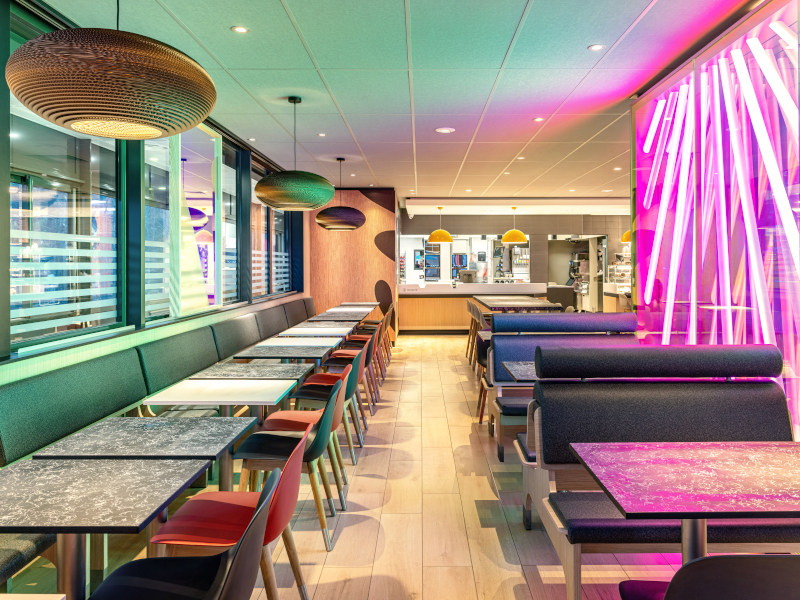
FOLLOWING A SUCCESSFUL launch of a sustainable design approach in McDonald’s restaurants in Carbonne and La Guerche de Bretagne, France, WeWantMore developed a new scheme for the brand’s branch in Bourse, Brussels. As McDonald’s works to meet its 2050 net-zero target, the team commissioned the studio to once again create a sustainable design for its dining areas, focused on decor circularity.
Antwerp-based WeWantMore worked closely with McDonald’s to create a dining area experience that would exist not just as a one-off restaurant, but one that could be scaled to other McDonald’s outlets around the world. This was developed by a measurement index together with the sustainability consultancy Anthesis, which tracks the circularity of the company’s global restaurant décor. The sustainable design of the restaurants significantly improves McDonald’s scores on the indicator with a focus on simplicity and disassembly.
 Ruud Belmans, creative director at WeWantMore, says they wanted ‘to show that sustainable design can be bold and fun and make a huge difference at the same time’. Image Credit: Mathieu Lipsteinas
WeWantMore strived to simplify the material palette towards the use of monomaterials, and the décor built for this restaurant model can easily be taken apart. Pieces are held together using mechanical fixings, instead of glue, so local teams can more effectively break restaurant features down by raw material type, with the goal of recycling or reusing. It says this process is more sustainable than the alternative because metals or woods treated with certain laminates or glues are not designed for re-use.
Other sustainable features of the new pilot restaurants included the removal of powder coating from all furniture and décor elements to facilitate greater reuse of steel components in the future, and the removal of laminates – which are notoriously challenging to recycle – from all furniture and décor elements.
Over 80% of the wood used is PEFC certified, from the tree to the restaurant, while 100% of the plastic used in tabletops and low stools, and at least 80% of the plastic used in chairs, is recycled content. The floor is also 70% cradle-to-cradle certified and the ceiling 100% certified.
Stephen Douglas, vice president of global restaurant design at McDonald’s, says: ‘Our new McDonald’s restaurant design bridges creativity and sustainability through a focus on décor circularity, elevating the way design meets the needs of our customers and employees. Not only does the new décor have a bright, optimistic look, but the circularity principles provide a sunny outlook to the future of how we will be feeding and fostering community.’
Ruud Belmans , creative director at WeWantMore, adds: “With this concept we want to show that sustainable design can be bold and fun and make a huge difference at the same time. The biggest gains were to be found in selecting the right materials and in engineering the furniture and interior features from scratch while simplifying wherever possible.” www.wewantmore.studio