
Alison Brook Architects incorporates Corian in London residence
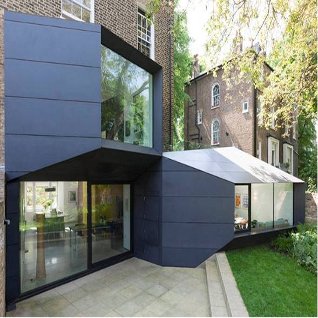
UK-based Alison Brook Architects has employed the award-winning Corian material from Dupont to create a facade for a residence in north London.
The brief given to Alison Brook Architects was to replace a two-storey rear bay extension and add an impressive side extension to the north London residential house. The biggest challenges were the position of a 150-year-old walnut tree with Tree Preservation Order and a Victorian sewer running through the back garden.
The redesigned house features an open plan kitchen/dining space with sliding glass doors at garden level, a cantilevered expansion of the living space which opens to a terrace, and a new garden level home office with its own entrance from a stepped-down patio at the front of the house.
A notable element of the house is a rain screen façade made from DuPont Corian hi-tech surface. Featuring geometric elements, the panels of Corian clad exterior of the facade, provides both aesthetic fascination and durable functionality. It is designed to provide a three-fold enhancement to the property.
The complexity of the building geometry demanded a rainscreen cladding material that is flat, dimensionally stable and which could be cut to precise shapes. The architects originally proposed creating the cladding with pre-patinated rigid zinc cassettes. Corian was preferred to create a distinctive, high-performance ventilated facade for its lightweight and easy-to-work properties. The material is also long lasting, versatile, good fire-rated, UV resistant in selected colours and easier to maintain.
In all, 260 square metres of Corian in the Blackberry Ice colour was templated, and then cut to individual panel sizes on site. The largest section used a standard full sheet of 760x3658mm. The panels were then installed using an adhesive system specifically formulated for aluminium rails, dressing the water tight structure. Off-cuts of the material were then taken back for use in training and other creative or sponsored projects.
The eight-sided trapezoidal form of the side extension keeps a low profile from the street, with undercut walls to avoid the tree roots. It also enables infiltration of natural light into the workspace. The planar geometry of the extension continues till the first floor bay window which focuses directly on the walnut tree. The point at which the side and rear bay window extensions merge, seven surfaces come together. Each trapezoidal plane of the scheme is either fully glazed or fully solid with no ‘punched windows’. Both roof and wall planes are made in one material, which enabled in creating an architecture without mass and weight. The structure resembles like the folded surfaces of origami.
In addition to the creation of a new facade, other changes were also made to the house like opening up the semi-basement and creating a double height living/kitchen space. The extensions have been designed to draw in light from the sky, embrace the garden, and capture a precise view of the massive walnut tree near the house.
Reflecting light in varying shades from silver-white to black, the faceted sides of the building change shades according to the weather. The vented rainscreen system allows for rainwater gutters and downpipes to be concealed underneath the cladding, producing a clean and sculptural architectural form.