
14th Venice Architecture Biennale
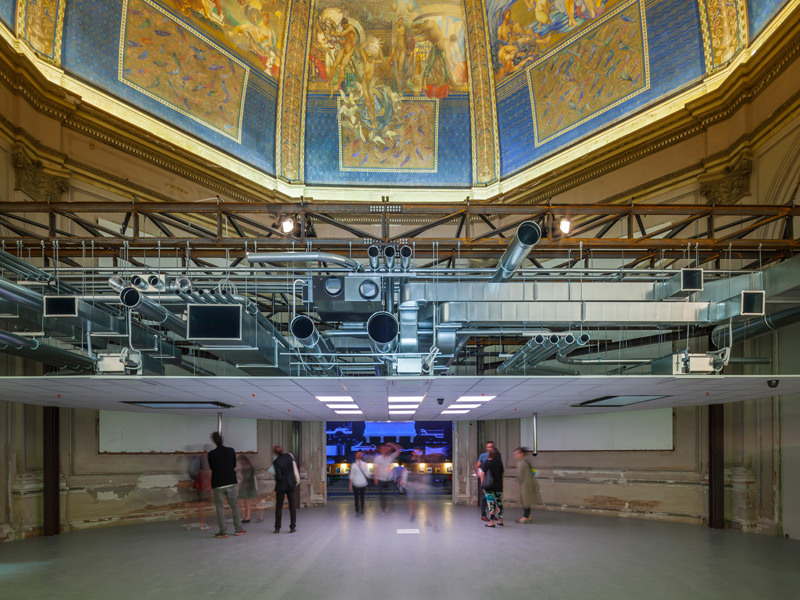
A look at this year’s research-centred festival, curated by Rem Koolhaas with the theme Fundamentals, showcasing our top 10 pavilions and the two contrasting exhibitions on display in the Giardini and Arsenale.

Words: Adrian Friend
Photography Paul Raftery
This year's Biennale takes a look at the nuts and bolts of how the mundane has influenced the contemporary world. Curator Rem Koolhaas placed particular emphasis on challenging popular myths and fallacies.
Francis Fukuyama's thesis on The End of History is widely credited with sealing the fate of the 'historical thinking', stripping the veneer off of any ideological alternative to liberal capitalism and crashing the meta-narratives of the 20th century into self-reflective panic. When Rem Koolhaas, the doyen of S,M,L and XL, was appointed curator of the 14th International Architecture Exhibition, in his 70th year, one sensed a similar wave rising in 'architectural thinking'. Presented as a choral research on architecture, Fundamentals, the title of this year's Biennale by Koolhaas, head of OMA and professor of Harvard University Graduate School of Design, looks at architectures past, present and future. Firstly he asked the national pavilions to explore the historic impact of the past 100 years of modernism in Absorbing Modernity. The present day is canonised in 15 booklets on Elements of Architecture that dominate the Central Pavilion, charting the impact of 20thcentury industrialisation on the built environment, where lifts, escalators and toilets dictate the way architecture is programmed.

Rem Koolhaas, now 70, relaxes for a brief moment in front of the Luminaire at the Arsenale. Photo: Gilbert McCarragher
Architectural futures is tackled in the Monditalia, where Italy is the empathetic host for testing and consuming culture, witnessed in 82 films and 41 architectural projects with space for first-time participations from the worlds of dance, music, theatre and cinema. For this Biennale, the image of the architect and products of their sole endeavours -- the 'masterpiece', is secondary, in its place, shared collaborations dominate, either technical, social or ideological such as neo-avant-garde group Superstudio, founded in Florence in 1966 whose The Secret Life of the Continuous Movement, shown at the 1978 Biennale, advanced towards symbolic representations of architecture where, 'Architecture exists in time as salt exists in water', where the only possible architecture, then is our own life.
It seems that to popularise architecture, Koolhaas feels the need for the architect to disappear, which has been a reoccurring theme in his oeuvre. As Bart Verschaffel states in The Survival Ethics of Rem Koolhaas on receiving the Rotterdam- Maaskant Prize in 1986: 'It is a remarkable feeling, but I am not an I. Throughout my career I have only written the word 'I' once, and that was in the sentence "I am a ghost writer". A ghost writer is someone who does not appear on stage himself, but remains in the background and speaks in the name of someone else.' This statement is unexpected and perhaps even sounds suspect from someone who has become one of the most famous and media-genic architecture stars. Yet in that same 1986 speech, he heralded this 'stardom' as 'a strategy': 'The mythology of the architect begs a reconstruction plan.'

The fireplace room of the Central Pavillion looked at the 'device-ification' of the central hearth. Photo: Paul Raftery
In the opening Biennale week debating '5000 years of architecture and technology, what next?', with CEO and inventor Tony Fadell of Nest Thermostats, Koolhaas reflected on digital technologies' desire to commodify architecture as well as predict and better human behaviour. 'I drive an old car and it frequently breaks down. Then I am asked to rent a new car that predicts my new speed and makes me behave better and be a better driver, almost all the aspirational words we use now include 'better' 'more responsible' -- what about transgression?'
By referring to In praise of shadows by Junichiro Tanizaki, comparing Japanese homes to those in Europe, where in 'household implements: we prefer colours compounded by darkness, they prefer the colours of sunlight', Koolhaas asks, 'Why deny these challenging qualities that also hold beauty?' and are now needed to break the current global homogeneity perpetrated by digital technology.
Reflecting on the merits of the Nest Thermostat, Koolhaas posits 'Well I have mixed feelings -- I admire the intelligence and the use as a tool to be frugal and responsible, but also a fundamental reluctance on my part to see architecture turned into products, and the relentless commercialisation of architectural elements.' In response to Fadell's assumption that, 'what you do will last for centuries -- what I do ages quicker within the year', Koolhaas reveals, 'The exhibition on the one hand shows the huge decrease in flexibility of materials, but in terms of appearance we are in the same world of accelerated ageing [where] confidence has crumbled, the permanence of architecture is a pathetic fiction now. Even if buildings last 25 or 30 years it is a miracle.'

Old door handles contrast with the security mechanisms embedded in airports Photo: Paul Raftery
For Koolhaas, the Biennale is a mirror on his thinking and desire to challenge the popular myths, perpetrated by the modernist narrative of the architect maestro, the sole author of a permanent architecture, fortified by manifestos and classical references to ancien regime. Koolhaas shows us that what was a gift for one generation is now a given for another -- a set change, no more than part of a performance. Famously credited with stating 'it's not me, it's made by OMA,' Koolhaas's design approach, recently unpacked by Albena Yaneva in An Ethnography of Design states: 'Just as it is impossible to understand Rembrandt's work without understanding the aspects of his studio practice along with his specific handling of paint, the theoretical treatment of his models and his relationship with the market, it is impossible to understand Koolhaas's work without considering his design practice.' Yaneva continues: 'The entire OMA design work revolves around life as it is staged in the office; in model making, in the travels of the model, in studio events and situations of reuse. There, the architects are performers and spectators and architecture becomes part of the performance that we view.'